
A successful team building experience Luxembourg companies invest in goes beyond putting colleagues in a room together. It's designed around clear goals, tailored to the team's specific dynamics, and creates shared moments that strengthen trust, communication and collaboration. Simply booking an activity won't deliver results—your session needs structure, intention and a format that feels engaging, not forced.
Whether your team is cross-border, hybrid or fully in-person, Luxembourg's unusually distributed workforce—47% cross-border employees and 27.3% sometimes working from home versus 13.3% EU-wide—means connection doesn't happen by accident. After running hundreds of corporate cooking sessions across Luxembourg, we've learned that the best experiences start with honest diagnosis and end with real, applicable insights teams can carry back to work.
Key takeaways
- Define clear goals before choosing an activity—improved communication, trust-building or morale each require different formats.
- Tailor the experience to your team's size, dynamics, personalities and comfort levels to ensure genuine participation.
- Choose interactive, challenge-based activities like cooking classes that create shared accomplishment and natural collaboration.
- Always debrief—the learning happens when teams reflect on what they discovered and how to apply it.
- Make team building ongoing, not a one-off event, to sustain momentum and reinforce new behaviours.
Why team building experiences matter more now
Global employee engagement sits at just 20% according to Gallup's 2026 State of the Global Workplace, and manager engagement has fallen sharply. In Luxembourg's multilingual, cross-border environment, that challenge is compounded by distributed schedules, different commute patterns and hybrid work norms. Teams don't collide naturally in corridors or over lunch—they need structured moments to rebuild the informal connections that make collaboration frictionless.
Research also shows that three in four cross-functional teams underperform on key metrics. Concentrated events that rebuild coordination and strengthen weak ties can unblock work the org chart cannot. But only if they're done well.

Step 1: Know your why before you book anything
The biggest mistake is choosing an activity before defining the goal. A cooking class designed to onboard new hires looks completely different from one built to restore morale after a restructure or break down silos between departments.
Start by asking: what do we need this session to achieve? Common goals include:
- Improve communication and collaboration across teams or functions
- Build trust and psychological safety, especially in newly formed or hybrid teams
- Boost morale after a difficult period or celebrate a milestone
- Strengthen weak ties and break silos between departments
- Onboard new hires into the team culture, not just the company
- Align strategy, goals or priorities at the start of a new quarter
- Develop problem-solving skills under time pressure or ambiguity
- Make company values feel real and lived, not rhetorical
A clear purpose guides every decision: the format, the facilitation style, the length, the debrief questions. Without it, you'll end up with a generic activity that feels disconnected from the real challenges your team faces at work.
Step 2: Tailor the experience to your team's reality
One-size-fits-all doesn't work. A high-energy sales team and a detail-focused engineering team will respond to completely different formats. Consider:
Team size. Smaller groups (8–12 people) allow deeper conversation and tighter collaboration. Larger groups (15–30+) need breakout formats or stations to keep everyone actively involved, not watching from the sidelines.
Personalities and energy levels. Does your team thrive on competition and fast-paced challenges, or do they prefer collaborative, low-pressure activities? Gauge comfort levels—forcing introverts into improv games or putting non-athletic colleagues through obstacle courses creates disengagement, not connection.
Cultural and language mix. In Luxembourg, many teams include colleagues from France, Germany, Belgium and beyond, often working in multiple languages. Choose activities where success doesn't hinge on fluency or cultural references. Cooking is universally accessible; a trivia quiz about British TV is not.
Hybrid and remote dynamics. If part of your team is remote, either bring everyone together in person for maximum impact or run a fully virtual session with shipped ingredient kits so no one feels like a second-class participant. Half-hybrid formats where some people are in a room and others on a screen rarely work.
Step 3: Choose activities that create real interaction, not passive participation
Generic icebreakers and trust-falls feel forced because they are. The best team building experiences disguise the "team building" inside an engaging, goal-oriented activity where collaboration emerges naturally.
Challenge-based activities that build problem-solving under pressure
Escape rooms, scavenger hunts and problem-solving puzzles encourage creative thinking, delegation and communication under time constraints. Teams learn to rely on each other's strengths, make quick decisions and adapt when plans don't work. They're fun, but they also surface real behaviours—who leads, who listens, who steps in when someone is stuck.
Creative and hands-on activities that shift perspective
Art workshops, improv games and cooking classes spark creativity and help colleagues see each other outside their usual roles. A finance director plating a dish alongside a junior developer creates a different kind of conversation than a boardroom ever will.
Cooking stands out because it's inherently collaborative, low-stakes and produces a tangible shared outcome. You don't need prior skill, there's no "winner," and everyone contributes—chopping, stirring, tasting, plating. It's also sensory and social: the smell of garlic hitting hot oil, the rhythm of a team working a menu together, the ritual of sitting down to eat what you've made.

Why cooking classes work as a team building experience Luxembourg teams choose
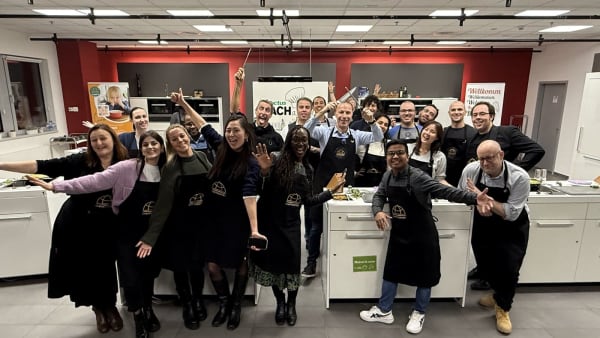
After hundreds of sessions with companies ranging from Amazon to the European Central Bank, we've seen how cooking creates the conditions teams need to collaborate well—without the awkwardness of activities that feel like "team building theatre."
Shared experience and camaraderie
Cooking together builds a sense of shared accomplishment. Everyone participates, regardless of culinary background. The junior hire who's never diced an onion works alongside the senior manager who cooks every night. Hierarchy softens. People laugh, ask for help, problem-solve together.
Communication and collaboration under real constraints
From planning the menu to coordinating who preps what, communication is essential. Teams learn to delegate, coordinate timing (when three dishes need to finish simultaneously) and give clear instructions under pressure. It mirrors the kind of coordination required in cross-functional projects, but in a context where mistakes are low-stakes and often funny.
Creative problem-solving and adaptability
Unexpected moments—an ingredient that cooks faster than expected, a sauce that needs rescuing, a last-minute substitution—become opportunities for on-the-fly decision-making. Teams that solve problems in the kitchen often recognise the same skills apply to work: staying calm, iterating quickly, asking for input.
Celebrating success together
Sitting down to share the meal you've just made is a ritual that reinforces team spirit. There's pride, relief, laughter and often surprise at what the group pulled off together. It's a tangible reminder that collaboration produces something greater than individual effort.
If you're looking for a team building experience Luxembourg teams genuinely enjoy, cooking offers the right balance of structure, challenge and fun.
Step 4: Always debrief—this is where the learning happens
The activity itself is only half the value. The debrief is where teams make sense of what they experienced and translate it into workplace behaviour.
Immediately after the session (or the next morning if the event ran late), gather the team for 15–30 minutes and ask open questions:
- What did you notice about how we communicated during the activity?
- When did collaboration feel easy? When did it feel hard?
- Did anyone discover a strength or skill in a colleague they hadn't seen before?
- What will you do differently in your next project based on today?
- What surprised you about how the team worked together?
Create space for honest reflection. Teams often surface insights about delegation, listening, decision-making speed or who steps up in ambiguity. These observations are gold—they're the raw material for better collaboration back at work.
Document key takeaways and share them with the team in writing. This anchors the learning and signals that the session wasn't just "a fun day out."
Step 5: Make team building ongoing, not a one-off event
A single session can't solve years of poor communication or weak trust. Team building is a process, not a checkbox.
Incorporate smaller, regular touchpoints into your team rhythm:
- Start Monday meetings with a two-minute check-in where everyone shares one word about how they're feeling
- Run quarterly half-day sessions focused on a rotating goal (one quarter: cross-team collaboration; next quarter: creative problem-solving)
- Celebrate milestones—project launches, individual promotions, team anniversaries—with shared rituals, not just Slack messages
- Acknowledge contributions publicly and specifically, not generically; well-recognised employees are 45% less likely to leave within two years
- Create informal spaces for connection: lunch-and-learns, coffee roulette pairings, hobby channels
The momentum from a strong team building session fades quickly unless you build structures that keep the conversation going.
How to measure whether your team building experience Luxembourg session actually worked
Measuring impact is harder than counting attendees, but it's essential if you want to improve future sessions and justify the investment.
Track both immediate reactions and longer-term shifts:
Immediate (within one week):
- Post-event survey: How engaging was the session? What was the single most valuable takeaway? What would you change?
- Participation rate and energy during the debrief
- Anecdotal feedback from managers observing the team
Longer-term (30–90 days):
- Observed changes in meeting dynamics, collaboration patterns or conflict resolution
- Employee engagement or pulse survey scores, especially questions about trust, communication and team cohesion
- Retention and internal mobility (teams that feel connected stay longer)
- Manager assessments: "Has cross-functional coordination improved since the session?"
Avoid vanity metrics like "we had 40 people attend." Focus instead on behaviour change and team health. 40% of event organisers still struggle to prove ROI—you'll stand out by designing for outcomes, not just outputs.
Common mistakes to avoid when designing a team building experience
After years of observing what works and what doesn't, a few patterns stand out:
Choosing the activity before diagnosing the need. The shiniest option isn't always the right one. Start with the goal, then reverse-engineer the format.
Forcing participation in physically demanding or emotionally vulnerable activities. Rope courses and trust falls alienate more people than they engage. Opt for inclusive formats where success doesn't hinge on athleticism or extroversion.
Skipping the debrief. Without reflection, the session is just entertainment. The debrief is where fun becomes learning.
Treating team building as a one-time fix. A single event can't repair broken trust or dysfunctional communication. Build it into your ongoing rhythm.
Ignoring hybrid or remote colleagues. If some people feel like outsiders, you've made the problem worse, not better. Commit to fully in-person or fully virtual—half measures backfire.
Using generic vendors who don't understand your team. The best sessions are co-designed, not off-the-shelf. Work with providers who ask questions about your goals, your team's dynamics and your constraints.
Why Luxembourg's distributed workforce makes intentional connection essential
Luxembourg's labour market is unlike most of Europe. With 47% cross-border workers, colleagues commute from France, Germany and Belgium, often on different schedules. 27.3% sometimes work from home—double the EU27 average—and 12.7% usually do. Add multilingual teams (French, German, English, Luxembourgish) and you have a workforce where informal, unplanned connection is rare.
This makes deliberate, structured team building more important, not less. The coffee-machine chat and Friday-afternoon drinks that build trust in other markets don't happen organically here. You need to design the moments where colleagues see each other as people, not just names in a calendar invite.
For more ideas on what works specifically in Luxembourg's context, see our guide to team building activities in Luxembourg.
Adapting your team building experience for hybrid and virtual teams
Not every session needs to be in-person. Virtual and hybrid formats have their place, especially for distributed teams or when budget and time are tight.
For fully remote or international teams, run live, hosted virtual cooking classes where everyone receives ingredient kits at home and cooks together on Zoom or Teams. It's intimate, interactive and creates the same shared-experience dynamic as an in-person session. We've run virtual events for Google, Amazon and dozens of other global teams—95% of organisers say experiential learning matters, and 53% of attendees plan to attend more webinars, but only if they're interactive, not passive.
For hybrid teams, either bring everyone to one location for maximum impact or commit fully to virtual. Half-hybrid—where some people are in a kitchen and others watch on screen—creates a two-tier experience. The remote participants feel like observers, not contributors.
Explore our virtual team building cooking class format if your team is distributed, or browse virtual team building activities that actually work for more ideas.
What to look for in a team building provider in Luxembourg
Not all providers are equal. Ask these questions before you book:
- Do they ask about your goals? A good provider diagnoses before prescribing. If they pitch a fixed menu without understanding your team's challenges, walk away.
- Can they tailor the session? Off-the-shelf formats rarely fit. Look for flexibility in group size, dietary needs, language mix and learning objectives.
- Do they facilitate, or just deliver? A facilitator guides reflection and draws out insights. A caterer just feeds people. You want the former.
- What's their track record? How many sessions have they run? For which types of companies? Ask for examples and, if possible, references.
- How do they handle logistics? Venue sourcing, dietary restrictions, timing, post-event follow-up—these details matter, especially for busy HR or operations teams.
- Do they offer post-session support? Debrief templates, follow-up activities, manager guides—providers who help you extend the learning are worth their fee.
ChefPassport has run hundreds of corporate cooking classes in Luxembourg for companies like Amazon, Google, the ECB and Deloitte. We design each session around your team's specific goals, facilitate the debrief and handle every logistical detail so you can focus on your people.
Ideas for different team building goals
| Goal | Recommended format | Why it works |
|---|---|---|
| Onboard new hires quickly | Collaborative cooking session with mixed teams | New joiners work alongside tenured colleagues in a low-stakes, social setting; accelerates relationship-building |
| Break silos between departments | Cross-functional breakout cooking stations | Forces collaboration across teams; creates informal networks that persist after the session |
| Rebuild morale after restructure or RTO | Celebration-focused cooking event with shared meal | Acknowledges the difficulty, creates positive shared memory, resets team energy |
| Strengthen trust and psychological safety | Facilitated cooking with guided debrief on communication styles | Cooking surfaces natural behaviours; debrief makes them discussable and actionable |
| Develop problem-solving under pressure | Timed cooking challenge with surprise constraints | Teams practise adaptability, delegation and decision-making in a compressed timeframe |
| Celebrate a milestone or high performance | Elevated multi-course cooking experience with wine pairing | Signals appreciation, creates memorable reward, reinforces "we value you" |
For onboarding specifically, see our deep-dive on new team onboarding activities that bond people fast.
Seasonal and cultural moments worth building events around
Timing your team building around natural calendar moments increases engagement and gives the session a narrative hook.
- Start of Q1: Align the team on priorities, reset energy after the holidays
- Mid-year: Reconnect after a busy H1, celebrate progress, course-correct if needed
- Autumn: Prepare for year-end push, onboard new graduates or seasonal hires
- December: Celebrate the year, thank the team, close out before holidays
Cultural and seasonal themes can also anchor the experience. A December cooking session featuring Luxembourgish winter dishes ties the event to place and season. A Chinese New Year team building event in January or February celebrates diversity and educates colleagues about traditions beyond the Luxembourg bubble.
For end-of-year celebrations, explore our list of corporate Christmas party ideas Luxembourg teams enjoy.
Investing in your team is investing in your company's future
A well-designed team building experience Luxembourg companies run isn't a perk or a nice-to-have. It's a strategic investment in the relationships, trust and communication patterns that determine whether teams execute well or stumble.
Global engagement is at historic lows. Cross-functional teams are underperforming. Hybrid and distributed work has made informal connection rare. In that environment, the companies that deliberately create moments for their people to see each other, solve problems together and feel genuinely valued will outperform those that don't.
Start with clear goals. Tailor the format to your team's reality. Choose activities that feel engaging, not forced. Always debrief. And make it ongoing, not one-off.
If you're ready to design a team building session that actually works—one your team will talk about for months, not tolerate for an afternoon—explore ChefPassport's corporate cooking classes in Luxembourg. We'll help you craft an experience that strengthens your team and delivers real, measurable outcomes.
Planning a team event?
ChefPassport runs hands-on cooking experiences for corporate teams — in person at Kachatelier, Luxembourg, and virtually worldwide. Instant price estimate on the site.
Frequently asked questions
Free guide
Team Building Menu & Pricing Guide
Menus, group sizes, formats and indicative pricing — everything you need to plan, in two PDFs. No spam, unsubscribe anytime.