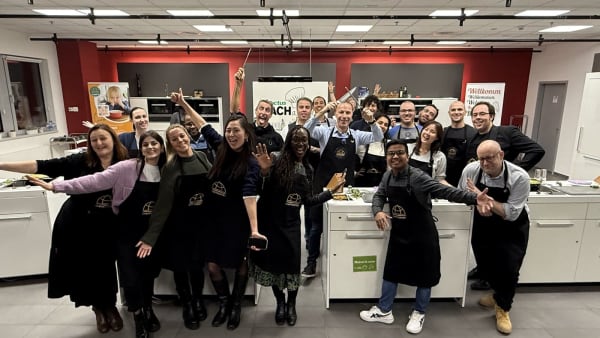

Most corporate team building activities don't fail because they're badly run. They fail because they were never going to work in the first place — a passive outing, a forced game, an afternoon nobody asked for. With global employee engagement sitting at just 20% (Gallup, 2026), the bar isn't "did people have an okay time." It's "did this rebuild any real connection between people who have to work together?" This guide ranks the most common corporate team building activities by what they actually deliver — honestly, including where our own format falls short — based on what we've seen across 200+ corporate events.
What a corporate team building activity is really for
Strip away the away-day clichés and a team event can genuinely move only three things. Connection — do people know and trust each other a little better than they did at 9am? Collaboration — can they coordinate under mild pressure without a manager refereeing? And belonging — do they leave feeling more like they want to stay? That last one quietly carries the ROI: well-recognised, connected employees are 45% less likely to have left two years later (Gallup/Workhuman). A single afternoon won't transform a culture, but it can reset the small human signals that culture is built from.
The activities that deliver share one trait: a shared task with a real outcome, where everyone has a role. The ones that disappoint are passive (you watch, you eat, you go home) or exclusionary (the same three extroverts run the show while everyone else checks their phone). Hold that lens against any activity and the list below sorts itself.
The activities, ranked by what they deliver
Tier 1 — shared hands-on creation (cooking, building, making)
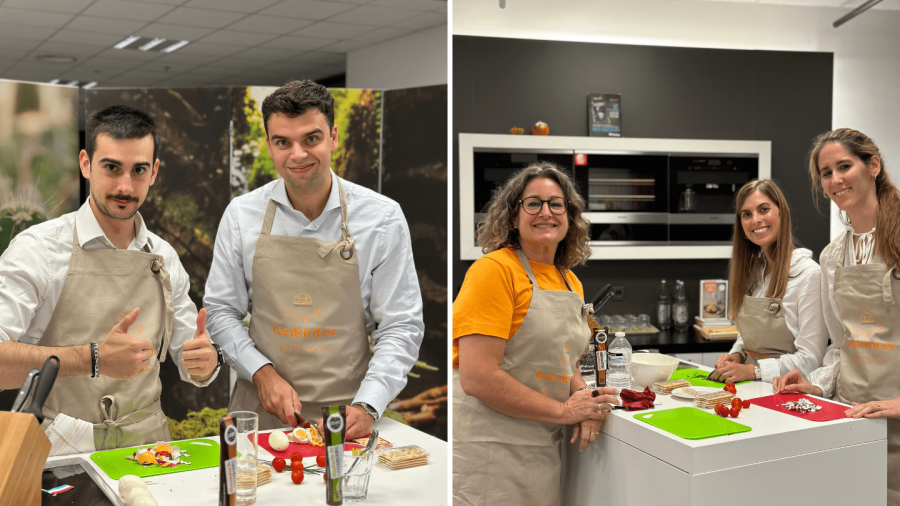
The strongest format — and not just because it's our business. The mechanism is simple: when a group makes something together against a gentle clock, coordination stops being a workshop abstraction and becomes real. Someone has to lead, someone preps, someone plates, and they have to talk to each other to get there. It flattens hierarchy in a way trust-fall exercises only pretend to — the new analyst runs the hot pan while the director chops onions, and for ninety minutes job titles genuinely don't help anyone. It's inclusive almost by accident: a quiet engineer who'd never speak up in a "share something about yourself" circle will happily own the sauce. And there's a shared artifact at the end — a meal the team made — that gives the day a memory to hang on, which is exactly what most events lack.
Where it falls short, honestly: it needs a real facilitator and a proper space, so it costs more than handing out a quiz. And if it's run as a passive cooking demo (chef cooks, team watches), it collapses straight into Tier 3. The value is entirely in the doing.
Tier 2 — structured problem-solving (escape rooms, build challenges)
Genuinely good for coordination under pressure and a fast energy hit, and they're easy to book. The limitations are predictable: they reward the loudest, quickest problem-solvers while quieter people get carried along; the experience is fixed, so you can't shape it to your team's actual dynamic; and the bonding tends to evaporate by the following Monday because there's no shared artifact to remember it by. Excellent as an occasional jolt. Thin as a recurring culture investment.
Tier 3 — social outings (dinners, drinks, sports days)
Low effort, low risk — and low depth. A nice dinner is a reward, not a team-building activity, and it's worth being honest about the difference: people sit with whoever they already know, conversation runs in the usual cliques, and nothing about how the team works together changes. There's nothing wrong with a good meal out — just don't put it on the team-building line of the budget and expect it to fix collaboration. It won't.
Tier 4 — volunteering and CSR days
Meaningful, and increasingly valued — younger employees in particular weigh purpose heavily in where they join and stay. When the cause genuinely fits the team, the bonding goes deeper than almost anything else on this list. The catch is logistics and authenticity: CSR days are heavy to organise, and if it reads as box-ticking rather than real commitment, everyone in the room can tell, and it can quietly do more harm than good.
Tier 5 — learning and skills workshops
Speakers, masterclasses, personality-profiling sessions. These can be valuable for individuals, but as team building they're a gamble: the format is usually passive, and "we sat through a workshop together" rarely builds connection. The exception is a workshop where the team has to apply something together in real time — at which point it's really a Tier 1 shared task wearing a learning label.
What's usually a waste of budget
Trust falls, mandatory "fun" with no shared task, anything where most of the group is an audience, and elaborate offsites whose actual content is a slide deck. The test is brutally simple: if people are watching rather than doing, it's an event, not a team building activity — and you're paying activity prices for a passive experience.
Why cross-functional teams need this most
If your teams span functions, the case sharpens considerably: three in four cross-functional teams underperform on key metrics (McKinsey) — usually because the weak ties between departments never formed in the first place. People coordinate well with their own team and badly across the org chart, and no process diagram fixes that. A concentrated shared experience that forces mixed groups to actually rely on each other is one of the few things that rebuilds those ties quickly — and it's precisely what a departmental dinner, where everyone sits with their own team, cannot do.
How to choose the right activity for your team
New or newly-merged team? Prioritise low-stakes shared tasks where everyone contributes equally and no one's existing status helps them — it's the fastest way to get strangers collaborating. (More on what bonds new teams in our guide to new-team onboarding activities.)
Remote or hybrid team? The shared-task principle holds; you just deliver it differently. Everyone cooking the same dish live on camera keeps the "everyone has a role" mechanic that a virtual quiz throws away.
Cross-functional or post-reorg? You need connection across silos, so deliberately mix the groups and pick something that makes them coordinate, not compete.
Leadership team? Lean into formats that quietly surface delegation, communication and decision-making under light pressure — you learn more about how a leadership team really operates from forty minutes of shared cooking than from a day of strategy slides.
Luxembourg-based? If you're hosting in person locally, our corporate cooking classes in Luxembourg are built for exactly this; the same format runs virtually for distributed teams.
What to budget — and what to ignore
Be wary of two pricing traps. The first is the cheap option that's secretly a Tier 3 outing — you save money and get morale, not team building. The second is the expensive offsite where most of the cost is venue and catering wrapped around a passive agenda. The honest framing on format: 78% of event organisers say in-person events are their most impactful channel (Bizzabo, 2026) — but only when the in-person time is active. Getting forty people into an expensive room to watch a presentation wastes the room. Spend on the doing, not the trimmings, and insist the logistics are handled for you so your organiser can be a participant rather than a stage manager.
How to actually run one well
Pick a shared goal, not a schedule of games. One thing the team makes or solves together beats five disconnected activities stitched into an agenda.
Mix the groups deliberately. Seat people across functions and seniority — the weak ties are the entire point, not the comfortable ones.
Right-size the format. 8–40 works for most hands-on activities; past that you need something built to scale rather than a big version of a small format.
Hand off the logistics. The organiser shouldn't be running the event. Fully managed means you actually take part.
Debrief lightly. Five minutes of "what surprised you about how we worked together today" turns a nice afternoon into one people reference months later.
How to tell if it worked
You won't get a clean productivity number, and anyone who promises one is selling — most of this evidence is correlational, not causal. But there are honest signals in the weeks after: people from different teams talking who didn't before, quieter team members a little more visible, in-jokes that trace back to the day, and the simplest one — do people ask when the next one is? If the answer is yes, the connection was real.
If you want the short, evidence-backed version to forward to a budget-holder, we keep an honest business case for cooking team building — and you can get an instant estimate and a tailored proposal in about a day.
Planning a team event?
ChefPassport runs hands-on cooking experiences for corporate teams — in person at Kachatelier, Luxembourg, and virtually worldwide. Instant price estimate on the site.
Frequently asked questions
Free guide
Team Building Menu & Pricing Guide
Menus, group sizes, formats and indicative pricing — everything you need to plan, in two PDFs. No spam, unsubscribe anytime.