Key takeaways
- Exit-interview patterns and engagement studies link retention to five activity characteristics: peer learning, cross-department connection, cultural celebration, skill-building and shared meals.
- Well-recognised employees were 45% less likely to have changed employers two years later, and three in four cross-functional teams underperform—focused company activities can address both.
- After running hundreds of corporate cooking sessions we've found activities work when they're interactive, multi-sensory, repeatable and inclusive by design—not passive spectator events.
- Cooking team-building combines all five retention drivers in a single format: hands-on skill transfer, natural cross-team conversation, cultural exploration, tangible achievement and a shared table.
Why company activities matter more than employee perks
Company activities—the deliberate, shared experiences an organisation creates—differ from employee perks in one critical way: they build connection, not just satisfaction. A gym membership or free lunch is valuable, but it's transactional. An activity that brings people together to learn, solve problems or celebrate creates relationships, trust and belonging—the social fabric research links to retention.
Gallup's 2026 State of the Global Workplace found global employee engagement sits at just 20%, and remote employees—while sometimes more engaged—report higher rates of stress, sadness and loneliness. That backdrop makes deliberate connection efforts matter more, not less.
After running hundreds of virtual cooking team-building sessions and in-person culinary events in Luxembourg, we've observed a pattern: the activities that People & Culture teams repeat year after year share five characteristics. They create peer learning, strengthen weak ties across departments, celebrate cultural identity, build tangible skills and centre around a shared meal.
The five characteristics of company activities that correlate with retention
1. Peer learning (not top-down training)
People retain what they discover together more than what they're told. Peer learning—where colleagues teach, troubleshoot and experiment side by side—builds confidence and reduces hierarchy. In cooking sessions, a junior developer often teaches a senior finance manager how to fold dumplings; the reversal of status creates openness.
Younger workers are strongly motivated by learning and meaning, according to Deloitte's 2025 Gen Z and Millennial Survey. Company activities that deliver skill transfer—rather than passive inspiration—align with what talent actually wants.
2. Cross-department connection (rebuilding weak ties)
McKinsey research found three in four cross-functional teams underperform on key metrics. The reason is often structural: org charts optimise for reporting lines, not collaboration. Concentrated events that rebuild coordination and weak ties can unblock work the org chart cannot.
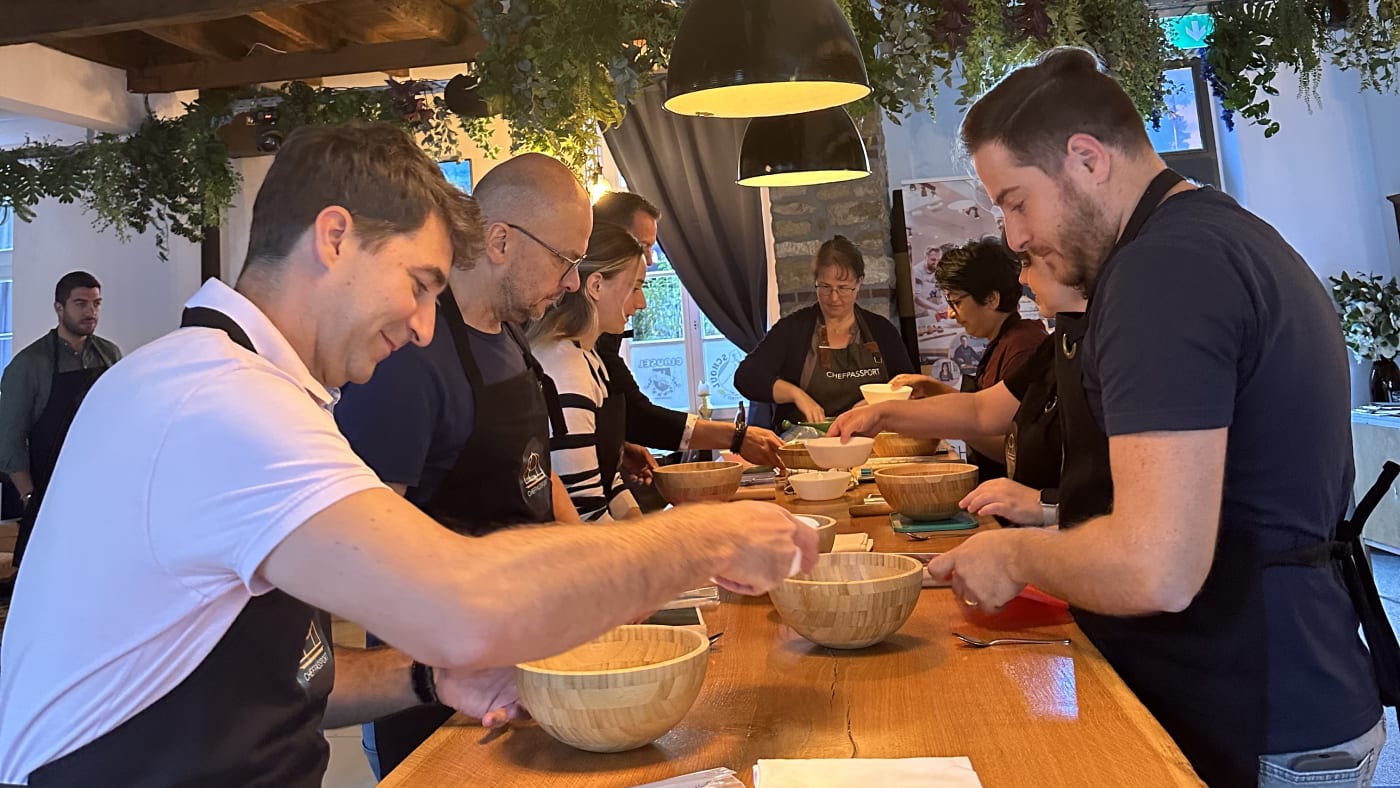
Cooking sessions naturally mix departments because seating and breakout teams are random. A marketing manager ends up chopping alongside a logistics coordinator; conversation shifts from recipes to process bottlenecks. These informal exchanges often surface problems formal meetings miss.
3. Cultural celebration (identity and inclusion)
Company activities that honour cultural identity—whether national heritage, regional cuisine or personal tradition—signal belonging. Randstad's Workmonitor 2025 found belonging and community matter materially in employer choice, and exclusion risk is real. Event design needs to support inclusion by default.
We've run Thai, Moroccan, Italian, Greek and Luxembourgish cuisine sessions for multinational teams. When a colleague from Bangkok explains the balance of sweet, sour, salt and heat in Pad Thai, or a Luxembourger describes Judd mat Gaardebounen, the team learns culture through taste—not through slides.
4. Skill-building (tangible achievement)
Activities that produce a visible, take-home outcome—a dish, a prototype, a solution—create pride and memory. Passive events (a guest speaker, a video screening) can inspire, but they rarely stick. Hands-on formats leave people with proof they collaborated and succeeded.
In every cooking class, participants leave with recipes, photographs of their finished plates and—critically—the confidence that they can recreate the dish at home. That tangible achievement reinforces the experience long after the event ends.
5. Shared meals (the anthropology of connection)
Eating together is one of humanity's oldest trust rituals. Shared meals slow conversation, lower status barriers and create informal space for relationship-building. After running hundreds of sessions, we've found the best conversations happen during the tasting—not the briefing.
Remote and hybrid teams especially benefit from meal-based activities. Cooking team-building over Zoom replicates the dinner-table dynamic even when colleagues are in six countries; everyone eats the same dish at the same moment, and that synchrony matters.
Why most company activities fail the five-criteria test
Many traditional team events deliver entertainment but miss the connection that drives retention. Here's why the usual formats struggle:
| Activity type | What it delivers | What it misses |
|---|---|---|
| Guest speaker / keynote | Inspiration, external perspective | Peer interaction, skill transfer, cultural relevance |
| Sports day / paintball | Energy, competition, physical release | Inclusion (fitness variance), skill retention, shared meal |
| Happy hour / drinks | Informal conversation, celebration | Learning, tangible outcome, inclusion (alcohol-centric) |
| Escape room / quiz | Problem-solving, teamwork under time | Cultural depth, take-home skill, meal ritual |
| Passive webinar | Information, convenience, scale | Peer connection, hands-on learning, sensory engagement |
None of these are bad—but none combine peer learning, cross-team mixing, cultural celebration, skill-building and a shared meal in a single format. That's why People & Culture teams often run multiple events to achieve what one well-designed activity could deliver.
How cooking team-building delivers all five criteria at once
Cooking sessions are the rare company activity that ticks every retention-linked box. Here's how the format works in practice, based on 200+ events we've hosted for Amazon, the European Central Bank, Deloitte and others.
Peer learning: Participants teach one another techniques—knife skills, emulsification, folding pastry—without a hierarchy. A colleague who cooks at home becomes the expert; status flips.
Cross-department connection: Breakout teams are assigned randomly, mixing finance, engineering, HR and operations. Chopping vegetables together sparks conversation that wouldn't happen in a conference room.
Cultural celebration: Menus explore Thai, Moroccan, Italian, Greek and Luxembourgish cuisines. Colleagues share stories about family recipes, regional ingredients and food traditions—identity becomes part of the session.
Skill-building: Everyone leaves with recipes, techniques and the confidence to recreate the dishes. The learning is tangible and repeatable.
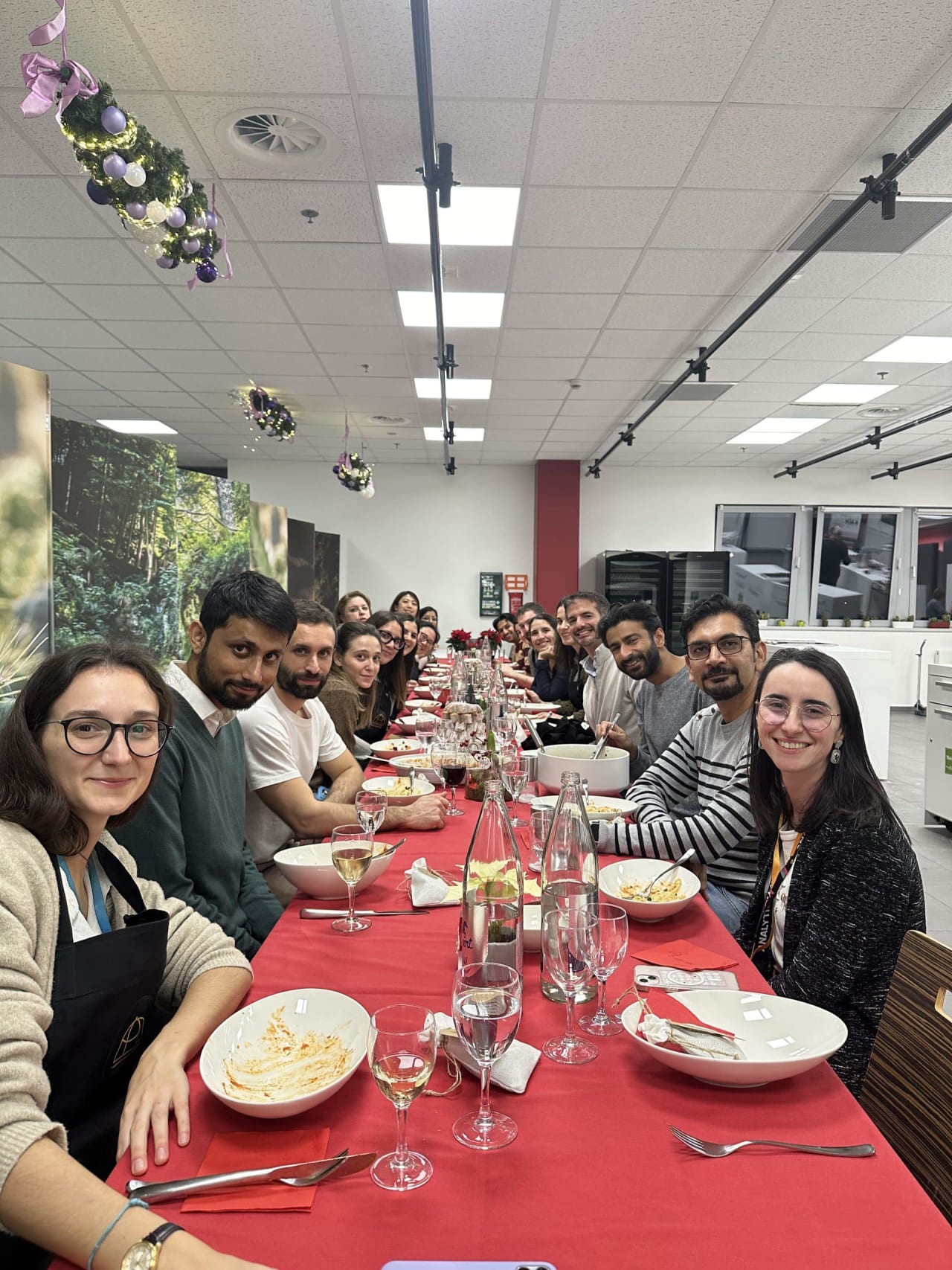
Shared meal: The session ends with everyone tasting their work together. That moment—passing plates, comparing flavours, laughing over mistakes—is where connection solidifies.
We've found smaller breakout teams (four to six people) create more participation than large-group formats. Participants rotate roles—one person preps, another stirs, a third plates—so no one is passive. The structure forces interaction, but the food makes it natural.
When to prioritise company activities over individual perks
Not every retention challenge needs a team event. Individual perks—flexible hours, learning budgets, wellness support—matter. But certain moments demand shared experience:
- After a reorganisation or acquisition, when team composition has changed and trust needs rebuilding.
- During hybrid or remote transitions, when weak ties fray and informal connection disappears.
- For new-team onboarding, when early relationship quality predicts long-term retention.
- Following a difficult quarter, when morale is low and people need visible investment and recognition.
- To celebrate a milestone, when shared achievement deserves a shared ritual.
- When cross-functional collaboration is stuck, and formal process fixes haven't worked.
Gallup and Workhuman research found well-recognised employees were 45% less likely to have changed employers two years later. Company activities—when designed well—function as high-quality recognition: they're visible, inclusive, memorable and tied to values.
What People & Culture teams ask before booking a company activity
After hundreds of event-planning calls, the same questions surface. Here's what matters:
Does it work for remote, hybrid and in-person teams? A format that only succeeds in person excludes distributed colleagues. Cooking works in both settings: we've run remote team-building sessions for globally distributed teams and in-person events in Luxembourg kitchens.
Is it inclusive by design? Dietary restrictions, physical ability, cultural and religious considerations must be embedded in the format—not added as afterthoughts. We adapt menus for vegan, halal, kosher and allergen-free needs; no one watches from the sidelines.
Can we measure impact? Bizzabo's 2026 research found 40% of organisers still struggle to prove event ROI, down from 70% in 2025. Buyers increasingly expect measurable outcomes. Post-session surveys, participation rates, follow-up feedback and repeat-booking behaviour all signal impact.
Will it scale or repeat? One-off events create memories; repeatable formats build culture. Cooking sessions work for twelve people or 120, quarterly or annually, and the structure adapts without losing quality.
Does it reinforce our values, or just entertain? The best company activities make values tangible. If your organisation prizes curiosity, collaboration and inclusion, a hands-on, culturally rich, team-based format aligns. A passive spectator event doesn't.
In-person vs virtual: which format drives retention?
Bizzabo's 2026 Event Marketing Statistics found the event mix is 63% in-person, 33% virtual and 4% hybrid. In-person is the anchor, but a third of events are still virtual—and Research and Markets estimates the global virtual-events market at $288.4 billion in 2026.
Each format has strengths. In-person events deliver sensory richness, spontaneous conversation and full presence. Virtual sessions offer repeatability, cost efficiency and true inclusion for distributed teams. Hybrid often delivers the worst of both: complexity without intimacy.
We run both. For Luxembourg-based teams or corporate Christmas parties, in-person cooking creates a stronger sensory anchor—the smell of garlic, the sound of sizzling, the rhythm of a shared kitchen. For multinational teams or quarterly check-ins, virtual cooking sessions eliminate travel friction and create repeatable connection rituals.
The retention driver isn't the format—it's whether the activity delivers peer learning, cross-team mixing, cultural depth, skill-building and a shared meal. Both can; most events do neither.
How ChefPassport designs company activities around the five criteria
We've run interactive cooking experiences for Amazon, Google, the European Central Bank, Deloitte, JP Morgan and 200+ companies since 2019. Every session is built around the same retention-linked principles.
Peer learning: Our chefs host and guide, but participants teach one another. We structure breakout teams so skill levels mix; confidence transfers peer to peer.
Cross-department connection: Seating and team assignments are randomised. HR meets engineering meets finance. Conversation starts with recipes and shifts to work, life and process—the informal exchanges formal meetings can't create.
Cultural celebration: Menus explore Thai, Moroccan, Italian, Greek and Luxembourgish cuisines, with stories about ingredients, regional traditions and family recipes woven into the session. Culture is tasted, not taught.
Skill-building: Every participant receives recipes, step-by-step instructions and technique coaching. The dishes are designed to be recreated at home—learning continues after the event.
Shared meal: Sessions end with everyone tasting their work together. That moment—passing plates, comparing results, laughing over near-disasters—is where connection solidifies. It's the anthropology of the dinner table, scaled for teams.
We adapt for dietary needs (vegan, halal, kosher, allergen-free), language preferences (English, French, Luxembourgish) and team size (twelve people or 120). The format works virtually for distributed teams and in person in Luxembourg.
What to ask your provider before booking a company activity
Not all team-building formats are created equal. Here's what to verify:
- How do you ensure peer interaction, not just passive watching? If the answer involves "observe the expert," it's a demo, not peer learning.
- Do you randomise teams, or let people self-select? Self-selection reinforces existing cliques; randomisation builds new ties.
- Can you adapt for dietary, cultural and accessibility needs? Inclusion must be embedded, not bolted on.
- What do participants take away? Recipes, skills, photos, confidence—or just a memory?
- How many sessions have you run, and for which clients? Experience matters. A provider who has hosted two events cannot troubleshoot the way one who has run two hundred can.
If the provider can't answer these clearly, the event will likely entertain but not retain.
How to measure whether a company activity improved retention
Measuring the impact of team events is harder than measuring training ROI, but not impossible. Here's what to track:
Post-event surveys (immediately): Ask whether participants felt more connected to colleagues, learned something tangible and would recommend the activity. Scores below 8/10 signal a format problem.
Follow-up surveys (30 and 90 days): Did cross-team collaboration improve? Are people still talking about the session? Have they recreated the recipes or techniques?
Repeat attendance: If the same people sign up for the next session, the format works. If they don't, it doesn't.
Exit-interview mentions: Do leavers cite lack of connection, weak culture or feeling unseen? If company activities address those gaps, mentions should decline.
Retention cohort analysis: Compare retention rates for teams that participated in activities versus those that didn't. It's correlational, not causal—but over time, patterns emerge.
McKinsey research links stronger workplace networks to higher sponsorship, belonging and engagement—the "social capital" case for bringing people together. Company activities are one tool to rebuild that capital; measurement proves whether it's working.
Next steps: choosing company activities that align with your retention goals
Not every company activity needs to tick all five criteria. A quarterly town hall builds transparency; a volunteer day builds purpose. But when the goal is retention—especially for hybrid teams, cross-functional groups or new hires—peer learning, cross-department connection, cultural celebration, skill-building and shared meals deliver measurable, repeatable impact.
If you're planning team events for 2026, start by auditing what you already do. Does your calendar include activities that create peer interaction, not just top-down messaging? Do events mix departments, or reinforce silos? Are cultural identity and inclusion embedded, or added as afterthoughts? Do participants leave with a tangible skill, or just a photo?
After running hundreds of cooking sessions for corporate teams, we've found the simplest test: would your team ask to do this again? If the answer is yes, the activity works. If it's "it was fine," it doesn't.
Explore virtual team-building cooking classes for distributed teams or in-person culinary events in Luxembourg. Both formats combine the five retention-linked criteria in a single, repeatable session—peer learning, cross-team connection, cultural depth, skill transfer and a shared table.
Planning a team event?
ChefPassport runs hands-on cooking experiences for corporate teams — in person at Kachatelier, Luxembourg, and virtually worldwide. Instant price estimate on the site.
Frequently asked questions
Free guide
Team Building Menu & Pricing Guide
Menus, group sizes, formats and indicative pricing — everything you need to plan, in two PDFs. No spam, unsubscribe anytime.


