
Key takeaways
- Teambuilding Zoom sessions succeed when participants actively create something together, not when they watch or click through slides.
- Remote employees can be more engaged than some peers but are also more likely to report stress, sadness and loneliness—making deliberate shared experiences essential.
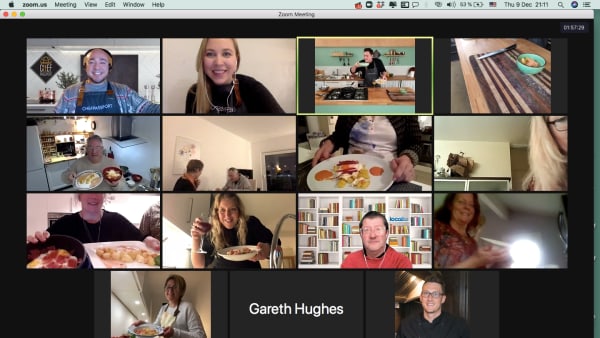
- Live cooking classes solve the core challenges of virtual team building experiences: camera-on participation, real-time collaboration, sensory engagement and a tangible shared outcome.
- The global market for corporate events virtual formats is estimated at $288.4 billion in 2026, and 53% of attendees plan to attend more webinars—but 95% of organisers say experiential learning matters, not passive consumption.
- Practical logistics—timezone scheduling, ingredient kits, tech setup and facilitation rhythm—determine whether a teambuilding Zoom event feels effortless or chaotic.
Why most teambuilding Zoom sessions fail

Most teambuilding Zoom activities feel like meetings with props. Trivia becomes a spectator sport for the loudest voices. Virtual bingo cards collect dust in breakout rooms. Icebreaker polls scroll past before anyone absorbs them. The problem isn't Zoom—it's the lazy assumption that activities designed for conference halls can be pasted onto video calls with a Kahoot overlay.
After running hundreds of virtual team-building sessions, we've identified three patterns that kill engagement:
- Passive consumption. Watching a magician, comedian or speaker might entertain, but it doesn't build relationships or collaboration muscle. Cameras stay off, chat goes quiet and people multitask.
- Low stakes and low agency. Games with arbitrary winners and no real choices feel performative. People comply because HR asked, not because the experience delivers value.
- No shared outcome. When the session ends and nothing remains—no artefact, no skill, no story worth retelling—there's nothing to anchor the memory or justify the calendar block.
Research from Gallup shows that remote employees can be more engaged than some peers but are also more likely to report stress, sadness and loneliness. Virtual teambuilding needs to address isolation and rebuild the informal connections that office kitchens and hallways used to supply—but most formats ignore this entirely.
What makes a Zoom team-building activity genuinely engaging
An effective teambuilding Zoom session transforms the screen from a broadcast medium into a collaboration space. That shift requires activities designed around three principles:
Hands-on participation, not spectatorship. Everyone must do something physical, creative or cognitive—preferably at the same time. Cooking, painting, building or problem-solving with real materials beats clicking through slides.
Real-time, visible collaboration. The activity should force communication, negotiation and mutual aid. Teams that have to coordinate timing, share tips or troubleshoot together in breakout rooms build the trust and informal ties that translate directly to work.
A tangible outcome people can see, taste or share. When participants finish a dish, complete a craft or solve a puzzle, they have proof they spent the hour creating something—not just consuming content. That artefact becomes a conversation starter and a positive anchor for the team memory.
According to Bizzabo's 2026 event marketing research, 53% of attendees plan to attend more webinars, yet 95% of organisers say experiential learning matters. The gap between demand for virtual formats and the quality of what's delivered is enormous—and teams that close it gain a competitive edge in retention and morale.
Why live cooking works better than games and icebreakers

Cooking is the rare activity that translates seamlessly from in-person to virtual while retaining sensory richness, creative agency and collaborative challenge. A virtual cooking class solves the structural problems that plague most Zoom teambuilding:
- Cameras stay on. People want to show their workspace, their ingredients and their progress. The chef and teammates become an audience worth engaging, not a grid to hide from.
- Everyone contributes at their own level. Confident cooks help nervous colleagues; dietary restrictions become opportunities for adaptation, not exclusion. Participation is inherently inclusive because the goal is learning and sharing, not winning.
- Conversation happens naturally. While dicing onions or waiting for water to boil, people chat, joke, ask questions and troubleshoot together. The rhythm of cooking mirrors the rhythm of good conversation—pauses, activity, revelation.
- You end with a meal and a skill. Participants eat what they made, share photos with families and often cook the dish again. The event creates a memory with a taste, a smell and a story attached—something trivia and bingo never achieve.
We've hosted sessions for globally distributed teams where participants joined from five continents and six time zones. The shared experience of chopping, sautéing and plating created more genuine laughter and connection in 90 minutes than months of standups ever did.
How to choose the right Zoom teambuilding format for your team
Not every virtual activity suits every team. The best teambuilding Zoom format depends on team size, goals, timezone spread and the specific connection gap you're trying to close.
| Format | Best for | Engagement level | Logistics |
|---|---|---|---|
| Live hosted cooking class | 5–200 participants; building trust, creativity and informal ties | Very high—cameras on, hands busy, real-time collaboration | Ingredient kits shipped or local shopping list; 90–120 min |
| Breakout challenges (cook-offs, quiz bowls) | Competitive teams; energising quiet groups | High for extroverts; can alienate introverts if poorly facilitated | Requires strong host to manage breakouts and debrief |
| Skill-building workshops (photography, cocktails, storytelling) | Learning-focused teams; onboarding cohorts | Moderate to high—depends on applicability to work or hobbies | Materials vary; works well asynchronously if recorded |
| Icebreaker games and quick energisers | Warm-ups; meetings under 30 min; new teams | Low to moderate—useful for priming, not for deep connection | Minimal; see our virtual icebreakers guide |
| Passive entertainment (comedy, magic, talks) | Rewards, celebrations; low-energy audiences | Low collaboration; high enjoyment if well-produced | Easy to scale; minimal interaction |
For distributed or hybrid teams, live cooking consistently outperforms passive formats because it turns video calls into shared creative experiences. For more Zoom-native ideas, explore our guide to virtual team building activities that actually work.
Practical tips for running a smooth Zoom team-building event
Execution determines whether a great concept lands or flops. Logistics that feel invisible to participants require careful planning behind the scenes.
Scheduling across timezones
For global teams, find the least-painful overlap. A 2 p.m. GMT session might mean 9 a.m. EST and 10 p.m. SGT—manageable once, but not weekly. If no single time works, run two identical sessions and mix breakout groups across geographies in follow-up work sessions.
Ingredient kits and tech setup
Ship ingredient boxes 5–7 days early, or provide a detailed shopping list with photos for teams sourcing locally. Include a tech-check email 48 hours before the event: camera angle (hands and workspace visible), audio quality and backup devices. Ask participants to prep ingredients—wash, measure, chop—so the live session focuses on technique and conversation, not hunting for a peeler.
Facilitation rhythm and breakout design
A good host alternates between full-group instruction, breakout collaboration and all-hands debrief. In a 90-minute cooking class, we typically run a 10-minute welcome and demo, 50 minutes of guided cooking with two breakout intervals for teams to share progress or troubleshoot, and 20 minutes for plating, tasting and reflection. The breakouts transform a cooking demo into a team-building experience.
Camera-on culture without coercion
Cameras stay on when people feel psychologically safe and the activity rewards visibility. Frame it as "we want to see your creations and cheer you on," not a compliance rule. In our experience, cooking naturally pulls cameras on because participants want to show off their mise en place, ask for visual confirmation and celebrate the final dish.
For async-friendly teams or those managing new hire onboarding, consider hybrid formats: live event plus a recorded replay and a dedicated Slack channel for photos and recipe swaps.
How cooking together solves real collaboration and communication goals
HR leaders don't run teambuilding Zoom events for entertainment—they're solving for trust, communication breakdown, silo mentality or morale erosion. Cooking addresses these goals more directly than most alternatives.
Building psychological safety. Cooking is forgiving. A burnt garlic clove or an over-salted sauce becomes a shared laugh, not a failure. Participants see teammates make mistakes, ask for help and recover—behaviour that models the psychological safety teams need to innovate and admit uncertainty at work. Peer-reviewed research links psychological safety to learning behaviour, efficacy and innovative performance.
Strengthening weak ties across departments. McKinsey research found that three in four cross-functional teams underperform on key metrics. Cooking classes intentionally mix breakout rooms—engineering with sales, London with Singapore—creating informal connections that unblock collaboration the org chart can't.
Making company values tangible. A session exploring Luxembourgish cuisine or Thai street food can reinforce values around diversity, curiosity and craftsmanship more memorably than a slide deck. The act of learning a new technique together embodies continuous learning and mutual respect.
Celebrating and rewarding invisibly. Remote work hides effort. A cooking event becomes a visible thank-you—an hour where leadership invests in joy, skill and connection, not deliverables. It signals that people matter beyond their output.
What to expect from a ChefPassport virtual cooking class
We've facilitated virtual cooking sessions for Amazon, Google, Deloitte and 200+ other companies—teams ranging from five people to 200, spanning every continent and dozens of cuisines.
Each session is hosted live by a professional chef who teaches, entertains and facilitates. Participants receive ingredient kits (shipped globally) or a detailed shopping guide. The format is interactive: the chef demonstrates a step, everyone cooks it, breakout rooms allow peer troubleshooting, then we regroup for the next technique. Menus range from Japanese gyoza and Italian pasta to Thai curries and Luxembourgish classics.
Sessions run 90–120 minutes. Teams finish with a restaurant-quality meal, new skills and dozens of photos for the company Slack. The experience is designed to feel less like a webinar and more like cooking with friends who happen to be scattered across the globe.
We also offer kit-enhanced formats for hybrid teams and async-friendly workshops for groups managing shift work or extreme timezone splits.
Common questions about teambuilding Zoom events
How do you keep energy high on a video call for 90 minutes? Variety in activity, breakout intervals and a charismatic host. Cooking naturally segments into steps—chop, sauté, assemble, plate—so the rhythm prevents monotony. We also build in moments to step away (while something simmers) and social time to chat while eating.
What if participants have different skill levels? A good chef tailors instruction to the room, offering shortcuts for beginners and refinements for confident cooks. Cooking is more forgiving than most assume—dishes turn out well even when techniques vary. The goal is learning and connection, not Michelin stars.
Can you accommodate dietary restrictions and preferences? Yes. Vegetarian, vegan, gluten-free, halal and allergy-friendly menus are standard. We ask about restrictions during planning and either adapt the core recipe or provide alternate ingredients in kits.
How far in advance do we need to book? For shipped kits, 3–4 weeks ensures reliable global delivery. For shopping-list events, two weeks is often sufficient. Last-minute requests are sometimes possible depending on team size and location.
Moving from Zoom fatigue to Zoom engagement
Teambuilding Zoom sessions earn their place on the calendar when they respect participants' time, intelligence and need for genuine connection. Passive entertainment and lazy icebreakers train teams to tune out. Hands-on, collaborative experiences—especially those that engage the senses and result in something real—turn video calls into moments people actually remember and talk about.
Cooking together transforms Zoom from a meeting prison into a creative, social space. It rebuilds the informal ties, shared stories and trust that distributed teams need to perform at their best.
If your team is spread across cities, countries or continents and you're looking for a virtual event that feels effortless to organise and genuinely engaging to attend, explore ChefPassport's virtual team-building cooking classes. Every session is tailored to your team size, goals and culinary interests—and designed to leave people energised, not exhausted.
Planning a team event?
ChefPassport runs hands-on cooking experiences for corporate teams — in person at Kachatelier, Luxembourg, and virtually worldwide. Instant price estimate on the site.
Frequently asked questions
Free guide
Team Building Menu & Pricing Guide
Menus, group sizes, formats and indicative pricing — everything you need to plan, in two PDFs. No spam, unsubscribe anytime.