Online team building games that actually work are experiential, not just clickable—they ask people to do something together, create something tangible, or solve a challenge collaboratively, not passively watch a screen or guess trivia answers. The format matters less than whether the game builds shared stories, reveals something human about colleagues, and transfers a skill or memory that outlasts the session.
After running hundreds of virtual team-building sessions for companies including Amazon, Google, the ECB and Deloitte, we've seen what separates team building online games that energise distributed teams from those that drain them. The difference is rarely the tech platform—it's whether the activity creates genuine interaction, respects meeting fatigue, and matches the outcome your team actually needs.
Key takeaways
- The best online team building games are hands-on and experiential—they involve creating, making or solving together, not just clicking or guessing.
- Match game style to outcome: trust-building formats require vulnerability and story-sharing; creative challenges spark innovation; pure-fun games recharge morale.
- Low-facilitator-effort games are repeatable but often shallow; high-touch experiences like live cooking classes create deeper connection and skill transfer.
- Remote employees can be more engaged than office-based peers but are also more likely to report stress, sadness and loneliness—deliberate shared experiences address that gap, according to Gallup's 2026 State of the Global Workplace report.
- The global virtual-events market is estimated at $288.4 billion in 2026, up from $235.4 billion in 2025—virtual formats are a durable, growing channel, not a pandemic stopgap.
Why most online team building games feel flat (and what works instead)

Most ranking listicles recommend Kahoot quizzes, virtual escape rooms, or Pictionary clones. They're easy to run, require minimal prep, and tick the "we did something fun" box. But after the third trivia round, participation drops. The camera-off rate climbs. People multitask.
The problem isn't that those games are inherently bad—it's that they're passive consumption dressed as interaction. One person speaks, everyone else clicks. No one learns a new skill, reveals anything personal, or creates something they can point to afterward. There's no story to tell over lunch the next week.
Games that work ask participants to make something, share something personal, or collaborate on a tangible outcome. They respect the reality that research from Gallup links remote work to higher stress and loneliness alongside engagement—so the format needs to create genuine human connection, not another screen to stare at.
Red flags for remote engagement
- One-to-many format: if only the host or one player is active at a time, engagement collapses after ten minutes.
- High cognitive load with no payoff: complex rules that take longer to explain than the game itself.
- No opt-out for introverts: forced vulnerability (e.g., "tell us your most embarrassing moment") without psychological safety backfires.
- Tech friction: requiring downloads, logins, or browser plugins adds drop-off before you even start.
- No memory hook: if participants can't recall what they did two days later, it didn't land.
Online team building games by outcome: trust, creativity, or pure fun
Not every team needs the same thing. A newly merged cross-functional squad needs trust-building; a burnt-out product team needs morale and laughter; a leadership cohort needs creative problem-solving. The game style should match the diagnosis.
| Outcome needed | Game style | Examples | Facilitator effort |
|---|---|---|---|
| Trust & psychological safety | Story-sharing, vulnerability, reflection | Rose/Thorn/Bud check-ins, personal timeline shares, strengths mapping | Medium—needs skilled facilitation to hold space |
| Creative spark & innovation | Problem-solving, making, building | Design sprints, live cooking challenges, collaborative art, build-a-contraption | High—requires materials, breakout coaching, debrief |
| Pure fun & morale | Low-stakes competition, laughter, nostalgia | Trivia, Pictionary, scavenger hunts, karaoke, murder mystery | Low—plug-and-play platforms, minimal prep |
| Skill transfer & learning | Hands-on practice, coaching, feedback loops | Virtual cooking classes, improv workshops, language lessons, presentation bootcamps | High—live expert facilitation, post-session reinforcement |
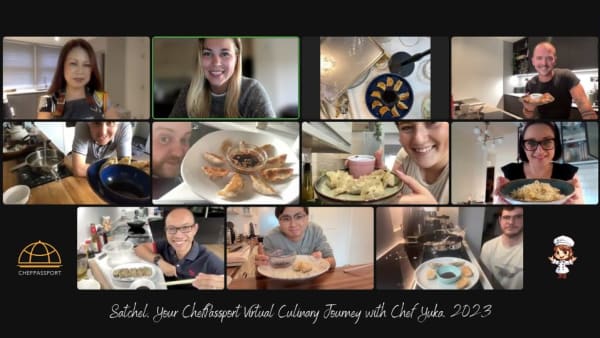
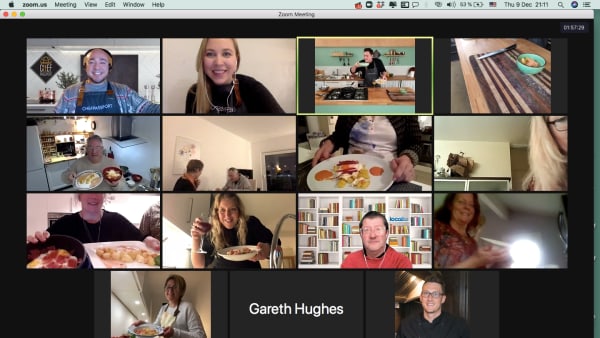
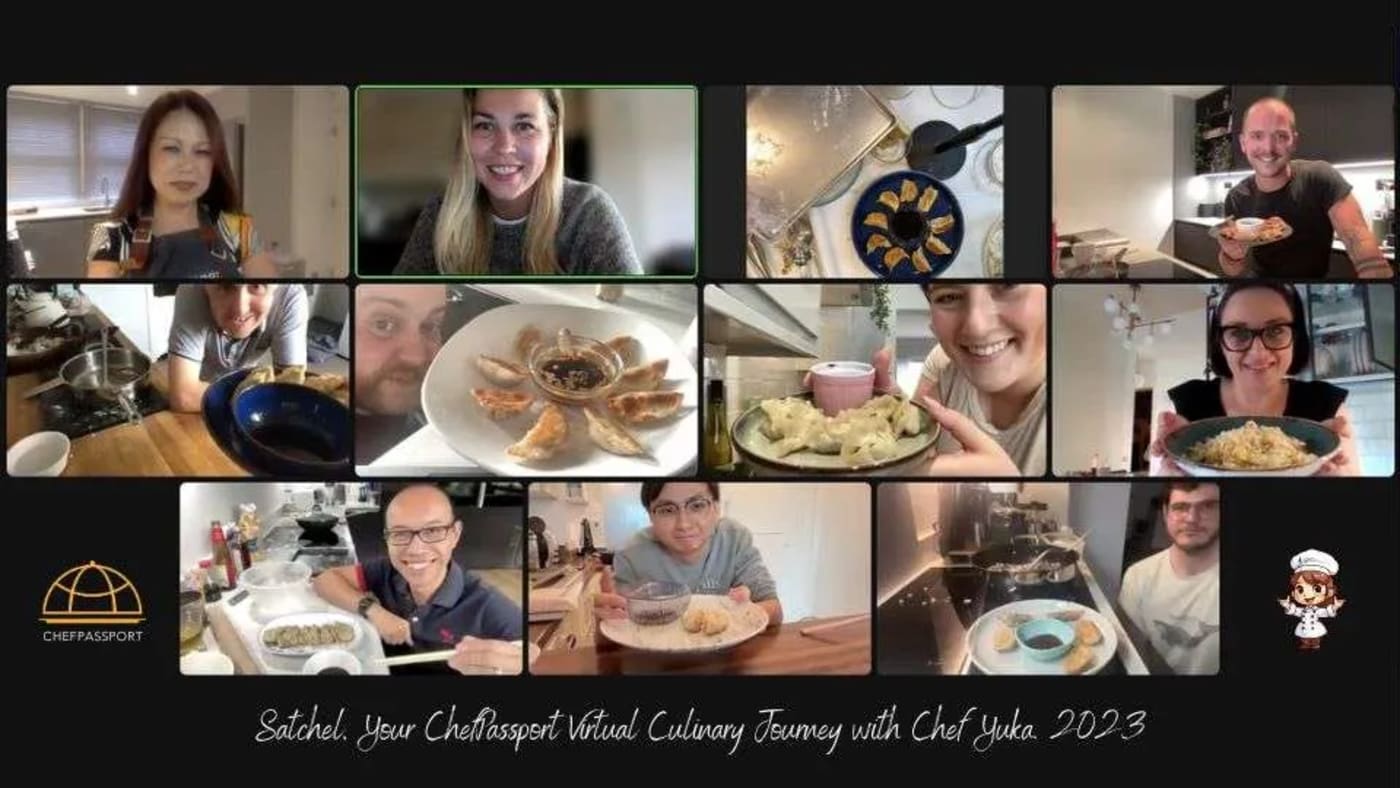
After hundreds of sessions, we've found that experiential, hands-on formats—especially live virtual cooking—create the deepest engagement and longest-lasting stories. Participants learn a real skill, collaborate in breakout teams, and produce something tangible (a meal they eat together on camera). The sensory experience—smelling garlic, tasting the dish, troubleshooting a sauce—creates memory anchors that trivia never will.
12 online team building games that create real interaction

1. Live virtual cooking class (hands-on, hosted)
Teams receive ingredient kits or shop from a list, then cook a complete meal together guided by a professional chef. Breakout rooms allow smaller groups to collaborate, troubleshoot and plate. Everyone eats together at the end.
Why it works: Combines skill-building, creativity, problem-solving and a shared sensory experience. Participants leave with a recipe they'll actually make again—skill transfer that lasts. Bizzabo's 2026 research shows 53% of attendees plan to attend more webinars and 95% of organisers say experiential learning matters—interactive, hands-on formats win over passive ones.
Facilitator effort: High (live chef, kit logistics) but repeatable and scalable. Ideal for 10–200 participants.
2. Virtual escape room (puzzle-solving, timed)
Teams work through a narrative puzzle—unlocking clues, decoding messages, solving riddles—within a set time limit. Platforms like Enchambered or The Escape Game offer polished experiences.
Why it works: Encourages logical thinking, delegation and communication under pressure. Best for small groups (4–6 per room).
Watch out: Can frustrate teams with uneven problem-solving ability; ensure a facilitator can drop hints.
3. Two Truths and a Lie (icebreaker, low-prep)
Each participant shares three statements about themselves—two true, one false. The group votes on which is the lie.
Why it works: Reveals unexpected personal facts, builds curiosity and warmth. Works well as a warm-up before deeper activities.
Facilitator effort: Minimal. Best for groups under 20; larger teams should use breakout rooms.
4. Online Pictionary or Gartic Phone (creative, laughter)
Drawing-and-guessing games using platforms like Skribbl.io or Gartic Phone (a digital "telephone" where drawings morph hilariously as they pass through the team).
Why it works: Low-stakes, high-energy, universally accessible. No artistic skill required—bad drawings often generate the most laughter.
Facilitator effort: Low. Works for 6–30 people.
5. Murder mystery party (role-play, narrative)
Teams receive character briefs and clues, then interrogate one another to solve a fictional crime. Providers like The Murder Mystery Co. or Night of Mystery offer ready-made kits.
Why it works: Encourages storytelling, improvisation and playful deception. Extroverts thrive; introverts may need encouragement.
Facilitator effort: Medium (pre-reading, character assignment). Best for 8–25 participants.
6. Virtual scavenger hunt (timed, competitive)
Participants race to find household objects, answer trivia, complete photo challenges or solve riddles. Platforms like GooseChase or Let's Roam automate scoring.
Why it works: Gets people moving away from their desks. Injects energy and friendly competition.
Watch out: Can exclude participants with limited mobility or home-office constraints.
7. Show and Tell (personal sharing, storytelling)
Each person brings an object with personal significance—a souvenir, a photo, a book—and shares the story behind it in two minutes.
Why it works: Creates vulnerability and empathy. You learn what colleagues value beyond work. For more icebreaker formats, see our guide to 30 virtual icebreakers for remote teams.
Facilitator effort: Minimal. Works for any size if you use breakout rooms.
8. Kahoot or Quizizz trivia (quiz, competitive)
Custom trivia on company history, pop culture, or team in-jokes. Fast-paced, points-based, live leaderboard.
Why it works: Familiar, easy to set up, generates quick energy. Best as a warm-up, not the main event.
Facilitator effort: Low to medium (question-writing). Works for 5–500 people.
9. Collaborative playlist building (async, creative)
Each team member adds 2–3 songs to a shared Spotify playlist on a theme (e.g., "songs that got us through 2025," "your personal hype track"). Discuss choices live or in Slack.
Why it works: Low-pressure, reveals personality and nostalgia. Creates a lasting artefact the team can listen to later.
Facilitator effort: Minimal.
10. Virtual improv games (spontaneity, storytelling)
Led by a professional improv facilitator, teams play games like "Yes, And…" story-building, freeze-frame scenes or emotion mirrors.
Why it works: Builds active listening, creative risk-taking and psychological safety. Laughter is a byproduct of trying, not perfection.
Facilitator effort: High (requires skilled host). Best for 8–30 participants.
11. Quickfire debates (structured, opinionated)
Assign fun, low-stakes debate topics ("Cats vs. dogs," "Pineapple on pizza: yes or no?") and give teams 90 seconds to argue each side.
Why it works: Encourages persuasive thinking, humour and playful conflict. Reveals how people argue ideas, not just execute tasks.
Facilitator effort: Low. Works for 10–40 people.
12. Breakout-room design sprint (problem-solving, collaborative)
Pose a real or hypothetical challenge (e.g., "Design an onboarding experience for a new hire in Antarctica"). Small teams sketch solutions, then present back.
Why it works: Mirrors real work, builds cross-functional collaboration, surfaces creative ideas you can actually use. For early-stage teams, see our guide to new team onboarding activities that bond people fast.
Facilitator effort: Medium (clear brief, timing, synthesis). Best for 12–50 people.
How to match game format to team dynamics and company culture
A game that energises a startup's scrappy product team might alienate a risk-averse finance department. Context and culture dictate format.
Consider your team's baseline
- Newly formed or post-reorg? Prioritise trust-building and story-sharing over competition. Low vulnerability first (desert-island favourites), then gradually deeper prompts.
- Burned out or Zoom-fatigued? Choose high-energy, low-cognitive-load games (Pictionary, scavenger hunts) or hands-on experiences that feel like a break, not another meeting.
- High-performing but siloed? Use collaborative problem-solving (design sprints, cooking challenges) to rebuild cross-functional ties. McKinsey research shows three in four cross-functional teams underperform on key metrics—events that rebuild coordination can unblock what the org chart cannot.
- Globally distributed with time-zone challenges? Offer async options (playlist-building, video show-and-tell) or rotate meeting times so no region always loses.
Respect introverts and neurodivergent participants
Not everyone thrives in high-stimulation, camera-on, rapid-fire formats. Build in:
- Optional participation (e.g., "Share in chat if you prefer not to speak").
- Advance notice of prompts or questions so people can prepare.
- Breakout rooms for smaller, lower-stakes interaction.
- Non-verbal ways to contribute (polls, emoji reactions, shared documents).
Inclusion isn't about lowering the bar—it's about widening the on-ramp so more people can show up fully.
Facilitator effort required: plug-and-play vs. bespoke experiences
Budget and bandwidth shape format. Here's the trade-off we see across hundreds of bookings.
| Effort level | What it includes | Best for | Limitations |
|---|---|---|---|
| Low (DIY or platform) | Kahoot, Skribbl.io, playlist-building, Two Truths | Recurring rituals, small budgets, internal facilitators | Shallow engagement; novelty wears off; no skill transfer |
| Medium (hosted vendor) | Virtual escape rooms, trivia hosts, murder mystery kits | One-off morale boosters, mixed-experience teams | Participants are consumers, not creators; limited customisation |
| High (live expert facilitation) | Cooking classes, improv, design sprints, workshop hybrids | Milestone events, leadership off-sites, skill-building goals | Higher cost and logistics; needs advance planning |
Low-effort games are repeatable and budget-friendly, but they rarely create stories people retell. High-touch experiences cost more but deliver memory, skill and connection that justify the investment—especially when retention, morale or cross-team collaboration is the strategic goal.
Why hands-on experiences like live cooking outlast trivia and escape rooms
We've hosted virtual cooking classes for distributed teams at Amazon, Google, Deloitte and 200+ other companies. The format consistently scores higher on post-event engagement surveys than passive games, and here's why.
Participants create something tangible
At the end of a cooking class, everyone has a plated meal. They've chopped, stirred, tasted and troubleshot. That dish becomes a conversational anchor: "Remember when half the team burned the garlic?" or "I made that Thai curry again for my family last weekend." Trivia leaves no artefact.
Sensory engagement beats screen fatigue
Cooking activates smell, taste, touch and movement—pulling people away from passive screen-staring into embodied action. Participants stand, chop, sauté and plate. The multisensory experience creates stronger memory encoding than clicking through slides.
Breakout collaboration mirrors real work
In our classes, small teams rotate through techniques—one person preps the aromatics, another manages timing, a third plates. It's low-stakes delegation, real-time feedback and shared problem-solving. Those dynamics transfer back to work projects.
Skill transfer with immediate reinforcement
Participants leave with a tested recipe, ingredient lists and techniques they can repeat at home. The learning sticks because it's practical, rewarding and social. Compare that to trivia: no one applies "obscure 1980s pop lyrics" on Monday morning.
Inclusivity across dietary needs and skill levels
Professional chefs adapt recipes for vegetarian, vegan, gluten-free and halal requirements. Beginners get more coaching; confident cooks get stretch challenges. Everyone eats together at the end—a ritual that builds equality and belonging.
For teams exploring how cooking-based learning differs from pure team-building, see our breakdown of online culinary school: team learning vs. team building.
Common mistakes when choosing online team building games
Picking a game because it's trending, not because it fits your team
Just because everyone on LinkedIn is posting about Wordle tournaments doesn't mean your compliance team will enjoy them. Start with the outcome you need (trust? energy? creativity?) and work backward to format.
Underestimating tech friction
Requiring participants to download an app, create an account, or troubleshoot browser permissions kills momentum before you start. Choose platforms that work in-browser with a single click.
No facilitator or MC
Even low-stakes games need someone to hold energy, manage timing, narrate transitions and rescue awkward silences. Don't assume the game will "run itself."
Ignoring time zones and work-from-home realities
Scheduling a 90-minute escape room at 7 p.m. CET excludes colleagues in Asia-Pacific and parents managing bedtime routines. Rotate inconvenient time slots or offer async alternatives.
One-size-fits-all repetition
Running the same trivia format every quarter trains people to tune out. Rotate game styles, rotate hosts, rotate themes. Novelty sustains engagement.
How to measure whether your online team building game actually worked
Attendance and laughter aren't enough. Bizzabo reports that 40% of event organisers still struggle to prove ROI—buyers increasingly expect measurable outcomes, not just smiles.
Immediate indicators
- Camera-on rate: did people stay visible and present, or did half the grid go dark?
- Chat activity: were people commenting, reacting, sharing spontaneously?
- Breakout-room energy: did facilitators report laughter, collaboration and time running over?
- Post-event survey sentiment: "Would you recommend this to another team?" (eNPS-style).
Delayed indicators (the ones that matter)
- Story retelling: do people reference the event in Slack, emails or standups days later?
- Behaviour change: for skill-building games (cooking, improv, design thinking), do participants apply the technique again?
- Relationship quality: do cross-functional colleagues who barely spoke before now collaborate more fluidly?
- Retention and belonging: Gallup and Workhuman research links well-recognised employees to 45% lower turnover two years later—events that make people feel valued contribute to that.
For broader context on virtual engagement, see our guide to 50 virtual team engagement activities that work.
When to move beyond games: virtual experiences that build skills and stories
Games have a ceiling. They energise, they break the ice, they create moments. But they rarely transfer skills, shift mindsets or create the depth of connection that transforms how a team works together.
If your team is facing:
- Chronic disengagement or belonging gaps,
- Weak ties across functions or geographies,
- Onboarding challenges for remote hires,
- Manager requests for "something that actually sticks,"
…then it's time to graduate from games to experiential learning formats—live workshops, hands-on skill-building, and hosted experiences that combine fun with function.
ChefPassport's virtual cooking classes do exactly that. Teams across 50+ countries cook restaurant-quality dishes together, guided by professional chefs, with ingredient kits delivered to their doors. Participants learn knife skills, flavour-balancing and plating. They collaborate in breakout rooms, troubleshoot in real time, and share a meal together on camera. The experience creates stories ("remember when the whole EMEA team made pad thai?"), transfers skills ("I've cooked that recipe three times since"), and builds the kind of human connection that makes Monday morning Slack feel warmer.
It's not a game. It's a shared accomplishment.
Final thoughts: choose games that respect your team's humanity
The best online team building games aren't the ones with the slickest app or the highest Google ranking. They're the ones that acknowledge meeting fatigue, respect different personalities, match the outcome you actually need, and create a story worth retelling.
Trivia and Pictionary have their place—quick energy, low stakes, easy laughs. But if you want connection that lasts beyond the Zoom room, choose experiences that ask people to make something, share something or learn something together.
Your team will remember what they created, not what they clicked.
If you're ready to move beyond generic games and explore a virtual team-building experience that combines skill-building, collaboration and genuine fun, discover ChefPassport's live virtual cooking classes—trusted by Amazon, Google, the ECB and 200+ companies worldwide.
Planning a team event?
ChefPassport runs hands-on cooking experiences for corporate teams — in person at Kachatelier, Luxembourg, and virtually worldwide. Instant price estimate on the site.
Frequently asked questions
Free guide
Team Building Menu & Pricing Guide
Menus, group sizes, formats and indicative pricing — everything you need to plan, in two PDFs. No spam, unsubscribe anytime.