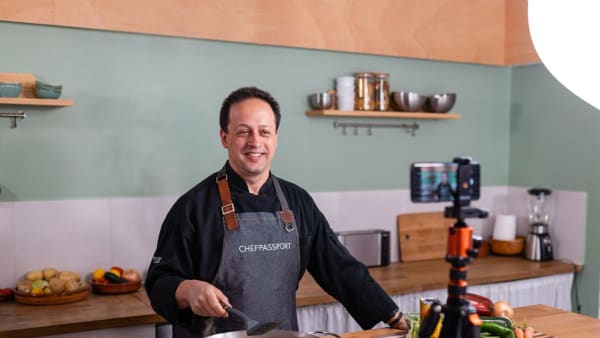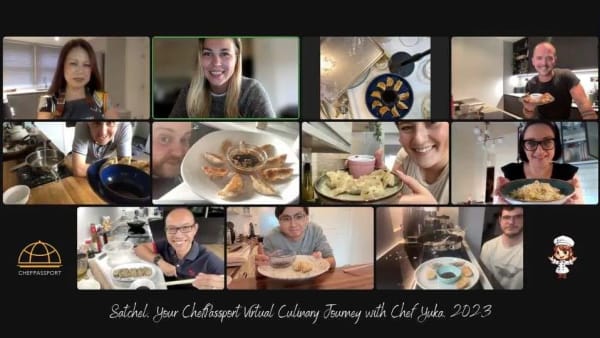

The two truths and a lie team building activity is a simple icebreaker in which each person shares three statements about themselves—two true, one false—and the group guesses which is the lie. It works best when embedded in a shared task like cooking, where the conversation flows naturally and participants have something to do with their hands while they listen and guess.
After running hundreds of cooking sessions for corporate teams, we've found that standalone icebreakers often feel forced. People answer dutifully, then wait for the "real" event to start. Two truths and a lie delivers better results when it's woven into an activity that already demands collaboration—chopping, stirring, tasting—so the game becomes part of the rhythm rather than an interruption.
Key takeaways
- Two truths and a lie is most effective when paired with a hands-on task like cooking, where conversation happens naturally around shared work.
- The game helps new hires, cross-functional teams and remote colleagues quickly learn memorable details about one another in a low-pressure format.
- Prompts tied to food, travel or work make the activity more relevant and less generic than random personal facts.
- Virtual formats work well in breakout rooms during the prep phase of a cooking class, giving smaller groups time to talk while they cook.
- The activity takes 10–15 minutes and needs no materials beyond the task already in progress.
Why two truths and a lie works in team building

Two truths and a lie works because it balances structure with surprise. Everyone gets equal airtime, the format is immediately clear, and guessing the lie creates a moment of curiosity and mild suspense. Participants reveal something real about themselves while controlling what they share—a safer dynamic than open-ended questions.
The game is especially useful for new teams, onboarding cohorts, or groups with quiet participants who struggle to jump into freeform conversation. Research links remote work to higher stress and loneliness, making intentional connection exercises valuable for distributed teams. Two truths and a lie offers that without requiring vulnerability or performance.
In our experience, the activity lands best when it's part of something else—preparing a dish, mixing cocktails, assembling dumplings. The cooking gives people permission to glance away, think while they stir, and respond without the pressure of a spotlight. The task also provides natural prompts: favourite ingredients, worst kitchen disasters, travel meals, childhood food rules.
How to run two truths and a lie during a cooking event

The simplest format is to introduce the game during the prep phase, when participants are chopping vegetables, measuring spices or assembling ingredients. Each person shares their three statements while they work, and the group guesses before moving to the next person. The cooking continues; the conversation layers on top.
In-person format: run it at individual workstations or in small teams of 4–6. If the group is larger, break into smaller cooking stations so everyone gets a turn without the activity dragging. Timing: about 10–15 minutes total.
Virtual format: use breakout rooms of 4–5 people during the first 15 minutes of cooking. Participants share while they prep their ingredients on camera. When breakout rooms close, reconvene and ask one or two volunteers to share their favourite lie from their group. This keeps the main room engaged without repeating every answer.
The host should go first to model tone and set expectations. A good opener might be: "I've cooked with a Michelin-starred chef. I once burned water. I make fresh pasta every Sunday." The first statement often becomes the teaching moment; the third reveals a habit; the second is usually the lie but framed as self-deprecating, which lowers the stakes for others.
Best prompts for two truths and a lie in a cooking context
Generic statements—"I have two siblings," "I've been to Italy," "I like dogs"—don't create much conversation. Food-related prompts give the activity more texture and connect it to the event at hand.
Food and cooking prompts:
- A dish I can make from memory
- A food I hated as a child but love now
- My worst kitchen disaster
- An ingredient I'd never cooked with until this year
- A meal that reminds me of home
Travel and culture prompts:
- A country where I've eaten street food
- A city I've visited three or more times
- A language I've tried to learn
- The strangest thing I've eaten abroad
Work and team prompts:
- A role I had before joining this company
- A skill I learned in the last six months
- A project I'm secretly proud of
- A work tool I didn't know existed a year ago
Prompts that invite a short story—"worst kitchen disaster," "strangest thing I've eaten"—generate more follow-up questions and laughter than static facts. The goal is to learn something memorable, not to catalogue trivia.
When to use two truths and a lie with your team
The activity works best in the first 20 minutes of an event, when energy is high and people are still settling in. It's especially effective for:
- Onboarding and new-hire cohorts: helps people learn names and a few defining details quickly. We've run it for onboarding programmes in Luxembourg where new joiners come from different departments and countries.
- Cross-functional or project kick-off teams: builds familiarity before collaborative work begins. Three in four cross-functional teams underperform, often because of weak interpersonal ties; icebreakers that reveal personality help.
- Remote and hybrid teams: gives distributed colleagues a structured way to connect beyond work talk. The global virtual-events market is estimated at $288.4B in 2026, and interactive formats consistently outperform passive webinars.
- Quarterly or annual gatherings: refreshes familiarity in teams that work together remotely but meet in person infrequently.
Avoid the game in high-pressure moments—strategy offsites, performance reviews, difficult conversations—where levity feels misplaced. It's a connector, not a problem-solver.
Why pairing two truths and a lie with cooking makes it more effective
Cooking gives people something to do while they talk. Hands are busy, eyes can look down at a cutting board, and there's no awkward spotlight. The activity becomes ambient rather than performative.
We've run two truths and a lie in breakout-room cooking classes for Amazon, Google and financial-services teams across Europe. The format works because the cooking task is collaborative and unfamiliar—most participants aren't professional cooks—so everyone starts on equal footing. The game adds warmth and personality to a session that would already involve teamwork, timing and a bit of chaos.
The food also creates natural follow-up. Someone mentions they grew up in Vietnam; five minutes later they're advising the group on fish sauce. Another admits they've never chopped an onion; someone else shows them a technique. The icebreaker doesn't end when the game does—it seeds conversations that continue through the rest of the event.
Common mistakes and how to avoid them
Making it too long: if everyone shares three statements in a 30-person group, the activity takes an hour and becomes tedious. Keep groups small (4–6 people) or run it in parallel breakout rooms.
No modelling: if the host doesn't go first, participants default to safe, boring statements. The host's example sets the tone for honesty, humour and relevance.
Skipping the "why": after someone reveals the lie, ask them to explain the two truths briefly. That's where the story and connection happen. "I did study in Japan—I spent a semester in Kyoto and that's when I learned to make ramen from scratch."
Forgetting to time it: the game should feel brisk. Give each person 60–90 seconds to share and hear guesses, then move on. If conversation organically extends, let it—but don't let one person dominate.
Using it as the only icebreaker: two truths and a lie is a strong opener, but it shouldn't carry the entire connection load. Pair it with a collaborative task—like a virtual cooking class or an in-person cooking challenge—that sustains interaction over 60–90 minutes.
Virtual vs in-person: what changes

| Factor | In-person | Virtual |
|---|---|---|
| Group size | 4–6 per cooking station | 4–5 per breakout room |
| Timing | During prep, ~10–15 minutes | First 15 min of breakout cooking |
| Facilitation | Host circulates, joins groups | Host briefs in main room, then participants self-facilitate in breakouts |
| Follow-up | Happens naturally as cooking continues | Reconvene in main room; 1–2 groups share a highlight |
| Energy | Louder, more spontaneous laughter | Quieter but still warm; relies on good camera presence |
Virtual sessions benefit from clearer instructions and a tighter timeframe. In-person events allow for more organic conversation and cross-group banter. Both work; the key is matching the format to the medium.
Variations and alternative icebreaker formats
If your group has done two truths and a lie before, try these cooking-friendly alternatives:
- Ingredient story: each person picks one ingredient on the table and shares a memory or fact about it. Quick, concrete, and everyone has something to say.
- Recipe swap: everyone names one dish they'd teach the group if they had time. Reveals skill, culture and personality in 30 seconds.
- Cook-off confession: participants admit one cooking myth they believed or one technique they still can't master. Self-deprecating and relatable.
- Two dishes, one dream: name two dishes you cook regularly and one you dream of mastering. Similar structure to two truths and a lie but food-focused.
For teams looking for more structured competition, consider running a full virtual cooking competition where icebreakers become part of the scoring or storytelling.
What we've learned running two truths and a lie in hundreds of cooking events
The activity works best when the host frames it as optional fun, not mandatory performance. Participants who feel forced to share often give flat, forgettable answers. Those who see it as a chance to be seen usually surprise the group.
We've noticed that multicultural and multilingual teams—common in Luxembourg, where 47% of employees are cross-border workers—appreciate prompts tied to food and travel rather than idioms or cultural references that don't translate well. Food is a universal entry point.
The lie people choose often says as much as the truths. Someone who invents an absurd falsehood ("I once cooked for the Queen") is signalling playfulness. Someone whose lie is subtle ("I've been to Tokyo twice" when it was actually three times) is showing they take the game seriously. Both are valuable data points for a team getting to know each other.
Finally, the game rarely stands alone as a memorable moment. What people remember is the cooking, the laughter when someone's sauce boils over, the collaboration, the meal they made together. Two truths and a lie is the opener—the catalyst that makes the rest of the event feel warmer and more connected.
Ready to try two truths and a lie with your team?
Two truths and a lie works when it's embedded in something collaborative, hands-on and a little bit unfamiliar. Cooking checks all three boxes. Whether your team is in one kitchen or spread across continents, the combination of structured storytelling and shared tasks creates connection without pressure.
If you're planning a session for a new team, a remote group, or a cross-functional project, consider pairing the icebreaker with a virtual cooking class or an in-person cooking event in Luxembourg. The game becomes the warm-up; the cooking becomes the team-building work that sticks.
Planning a team event?
ChefPassport runs hands-on cooking experiences for corporate teams — in person at Kachatelier, Luxembourg, and virtually worldwide. Instant price estimate on the site.
Frequently asked questions
Free guide
Team Building Menu & Pricing Guide
Menus, group sizes, formats and indicative pricing — everything you need to plan, in two PDFs. No spam, unsubscribe anytime.