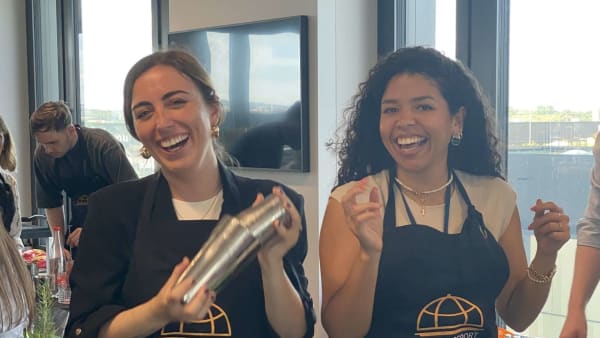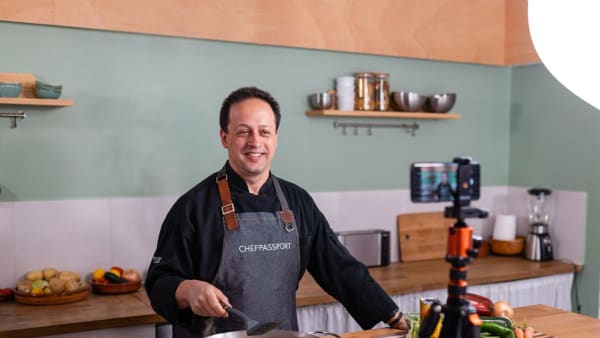

A virtual team event brings distributed colleagues together online for shared experiences that build connection despite distance. When Google's Asian YouTube division needed to unite their content team across Japan, Korea and Singapore in June 2022, they chose a 60-minute cooking session with ChefPassport's Chef David—a Roman Holiday menu that combined ease, taste and interaction in a single hour.
The session worked because it prioritised three things: a simple, iconic dish everyone could cook simultaneously; real-time interaction facilitated by an experienced virtual instructor; and a shared memory that outlasted the Zoom call.
Key takeaways
- Virtual team events suit distributed teams where in-person gathering is impractical or too expensive.
- Hands-on virtual team experiences—cooking, making, building—drive higher participation and memory than passive webinars; research by Bizzabo shows 95% of event organisers say experiential learning matters, and 53% of attendees plan to attend more webinars in 2026.
- Logistics matter more than agenda: timezone coordination, dietary handling, ingredient sourcing and tech setup determine whether the event feels seamless or stressful.
- Shorter sessions (60–90 minutes) fit busy calendars and maintain energy better than half-day workshops.
- The global virtual-events market reached $288.4 billion in 2026—virtual is a durable, strategic channel, not a pandemic workaround.
Why Google chose a virtual team event for their Asian YouTube division
Google's Asian YouTube content team spans multiple countries and timezones. Flying everyone to a single location for a two-hour social moment makes little financial or environmental sense. A virtual team event offered the same goal—connection, conversation, a break from screen-based work—without the travel overhead.
"Working remotely across different countries makes it harder to bond with your colleagues," said Midori Hirose, the event organiser. "With this ChefPassport session we built a team memory and a stronger relationship."
The format chosen—a 60-minute TeamCook with an Italian Roman Holiday menu—was designed for ease. Participants cooked simple, iconic Italian dishes under the live guidance of Chef David, one of ChefPassport's most experienced virtual instructors. The session replaced a static video call with something sensory: chopping, stirring, tasting and sharing the results on camera.

What a virtual team event actually looks like in practice
A virtual team event isn't a webinar with a Q&A. It's a synchronous, facilitated experience where participants do something together, not just watch someone present slides.
In Google's session, every participant had ingredients delivered or sourced locally (depending on the country and dietary needs). Chef David opened with a quick introduction, demonstrated each cooking step live on camera, then paused while participants replicated it in their own kitchens. The format alternated between instruction, cooking and conversation—jokes, pets wandering into frame, participants welcoming one another into their homes.
After running hundreds of virtual cooking sessions, we've found this rhythm—demonstrate, pause, cook together, share—creates far more engagement than a chef cooking solo while participants watch passively. The act of cooking side-by-side builds the connection; the food is the excuse and the reward.

The logistics that make or break a virtual team event
The difference between a smooth virtual team event and a frustrating one comes down to logistics, not creativity. Three areas determine success:
Timezone coordination
Google's team spanned Tokyo, Seoul and Singapore—relatively aligned timezones (UTC+8 to UTC+9). Even a two-hour spread requires careful scheduling. For teams crossing Europe and Asia, or the US and APAC, you either run two separate sessions or accept that someone joins at an awkward hour. We've hosted sessions where Singapore participants cooked breakfast while their Luxembourg colleagues made dinner.
Ingredient sourcing and dietary accommodation
ChefPassport ships full ingredient kits within Europe. For global teams, we provide detailed shopping lists, brand suggestions and local substitutes. Dietary restrictions—vegan, gluten-free, halal, kosher—must be captured during registration, not discovered the morning of the event. Google's organiser noted the support and flexibility throughout planning as a key reason the session succeeded.
Technical setup and platform
Most corporate teams use Zoom or Microsoft Teams. The instructor needs a multi-camera or overhead setup so participants can see both the chef's face and the cooking surface. Participants need stable internet, a working camera and ideally a laptop positioned where they can see the screen while cooking. We send a tech-check email 48 hours before every session with clear instructions and a test link.
These details sound mundane, but they're the difference between a memorable event and one derailed by missing ingredients or frozen video feeds.
Why cooking works better than most virtual team event formats
After hundreds of virtual sessions, we've observed consistent patterns. Cooking sessions generate higher participation, more natural conversation and stronger post-event feedback than trivia, escape rooms or passive talks.
The reasons are sensory and social. Cooking engages hands, smell, taste and problem-solving. It's forgiving—burnt garlic and uneven dice still taste good. It creates natural conversation anchors: "What does yours look like?" "Mine's sticking—what did you do?" "Should I add more salt?" The shared struggle and shared success build rapport faster than icebreaker questions.
Participants also leave with something tangible: a meal they cooked, a recipe card, a photo of their dish next to their colleague's on-screen. That physical artefact—dinner—extends the memory beyond the calendar invite.
Research supports this preference for experiential formats. According to Bizzabo's 2026 Event Marketing Statistics, 95% of organisers say experiential learning is important, and 53% of attendees plan to attend more webinars—but only if they're interactive, not passive.
What Google's organiser valued most
Midori Hirose highlighted three aspects in her feedback:
- Support throughout the planning process: Clear communication, fast responses and a single point of contact reduced organiser stress.
- Flexibility with dates, times and budget: Virtual events often require last-minute adjustments (timezone conflicts, headcount changes, budget approvals). ChefPassport accommodated date shifts and offered pricing that met Google's budget without compromising the experience.
- The team memory created: The session wasn't just a calendar block—it became a reference point. "Remember when we all cooked together?" is a stronger connector than "Remember that Zoom call?"
These outcomes align with what drives virtual team event ROI: not just attendance, but the relationship quality and memory persistence that follow.
When a virtual team event makes more sense than in-person
Virtual isn't always the right choice. In-person events remain the anchor format in 2026—Bizzabo reports 63% of events are in-person, 33% virtual and 4% hybrid. But virtual earns its place in specific scenarios:
| Scenario | Why virtual works | Why in-person might be better |
|---|---|---|
| Fully remote or dispersed teams | No travel cost; everyone joins equally | If the team has never met face-to-face, an annual in-person offsite builds deeper bonds |
| Frequent touchpoints (monthly socials) | Low friction; fits into working hours | Quarterly in-person events create higher-impact moments |
| Budget constraints | $30–60 per head vs $150+ for venue + catering | In-person justifies itself for milestone celebrations or annual kick-offs |
| Cross-border or global teams | Removes visa, travel and time-off barriers | Hybrid (regional hubs joining a central broadcast) can split the difference |
| Short notice or experimental formats | Can be organised in a week; easy to repeat if successful | In-person requires venue booking, catering lead times and travel coordination |
For Google's Asian YouTube team, the choice was clear: a one-hour virtual session delivered connection without the complexity of international travel.
Virtual team events in 2026: what's changed and what hasn't
The virtual event landscape has matured since 2020. Demand is stable and intentional, not emergency-driven. According to Research and Markets, the global virtual-events market grew to $288.4 billion in 2026, up from $235.4 billion in 2025. Europe's market alone is growing at roughly 18% annually.
What's changed:
- Higher expectations for production quality: Participants expect good lighting, clear audio and professional facilitation—not a shaky webcam.
- Experiential over passive: Webinars and panels are falling out of favour unless they include breakouts, polls or hands-on elements.
- Data-driven ROI: Bizzabo found that 40% of organisers still struggle to prove event ROI, down from 70% in 2025. Buyers increasingly expect measurable outcomes—engagement scores, post-event surveys, retention lift—not just attendance.
- Smaller, more frequent formats: Micro-events (30–60 minutes, monthly or quarterly) are replacing occasional half-day marathons.
What hasn't changed:
- People still crave real human connection, especially in remote-first cultures where Gallup's 2026 research links remote work to higher stress, sadness and loneliness alongside engagement.
- Logistics remain the hidden success factor—bad ingredient delivery or timezone chaos will kill an otherwise great idea.
- Food is universal. It crosses cultures, hierarchies and personalities better than almost any other team-building medium.
How to plan your own virtual team event (what we've learned from hundreds of sessions)
If you're organising a virtual team event for a distributed team, here's what actually matters:
1. Define the "why" before the "what"
Are you reconnecting a team after a reorg? Onboarding new hires? Celebrating a win? Rebuilding morale? The goal shapes the format. A celebration can be playful and loose; onboarding needs structured introductions and psychological safety. Don't pick an activity and retrofit a purpose.
2. Choose a format that creates interaction, not just attendance
Cooking, art workshops, mixology, storytelling exercises—anything where people make or share something together. Avoid formats where one person performs and everyone else watches. The 15 virtual team building activities we recommend all prioritise doing over watching.
3. Get the logistics right early
- Survey dietary needs and restrictions at registration, not the week before.
- Send ingredient kits (if Europe-based) or detailed shopping lists with local substitutes (if global) at least five days ahead.
- Pick a time that's tolerable for all timezones. If that's impossible, run two sessions.
- Send a tech-check reminder 48 hours before with Zoom/Teams link, camera-positioning tips and a contact for day-of issues.
4. Brief the facilitator on your team's context
A good instructor adapts tone, pacing and interaction style to the group. Tell them: team size, experience level (have they cooked together before?), any inside jokes or recent wins to reference, and the mix of introverts vs extroverts if you know it. Chef David knew Google's team was spread across countries and leaned into that—asking participants to share what their kitchens looked like, inviting pets on camera, celebrating the different ways people plated the same dish.
5. Follow up with a post-event artifact
Share photos, a recipe card, a short video montage or a group message thread. The event's value compounds when people can revisit and share it. Google's team had a Slack channel where participants posted their finished plates—a small detail that extended the conversation by days.
Real outcomes: what a successful virtual team event delivers
Measuring the ROI of team events is notoriously hard, but Gallup's 2026 State of the Global Workplace reminds us that engagement sits at just 20% globally, and remote employees—while sometimes more engaged—are also more likely to report stress and loneliness. Deliberate, recurring connection points help close that gap.
After hundreds of virtual sessions, we see three consistent outcomes when events are well-run:
- Stronger interpersonal relationships: Participants report feeling more comfortable reaching out to colleagues they cooked with, even if they'd never spoken before. Shared struggle (burnt garlic, missing ingredients) builds rapport faster than icebreaker questions.
- Increased participation in future sessions: Teams that run one successful virtual event typically book another within three months. The format becomes a cultural ritual, not a one-off experiment.
- Tangible memory and conversation anchor: "Remember when we all made pasta together?" is a reference point that lasts months. It's a small signal that the company invests in the team, not just the work.
For Google, Midori Hirose's feedback was clear: the session built a team memory and a stronger relationship across countries. That's the outcome a successful virtual team event should deliver—not just an hour filled, but a connection made.
Other virtual team event ideas (beyond cooking)
Cooking works, but it's not the only format. If your team has run multiple cooking sessions or has specific dietary or cultural reasons to avoid food-based activities, consider:
- Guided storytelling or "show and tell": Each participant shares an object from their home and the story behind it. Low-tech, high-emotion.
- Virtual art or craft workshops: Painting, origami, plant potting—anything tactile that doesn't require culinary skill.
- Mixology or coffee tasting: Similar logistics to cooking (shipped kits or shopping lists) but faster and lower stakes.
- Collaborative problem-solving: Escape rooms, murder mysteries or strategic simulations. These work better for teams that already know each other.
- Live music or cultural experiences: A musician teaching a song, a dancer leading a movement workshop, a local guide giving a virtual tour. These suit global teams celebrating diverse backgrounds.
For more ideas, see our guide to virtual team building activities that actually work and our list of 50 virtual team engagement activities.
Seasonal and occasion-specific virtual team events
Many companies anchor virtual events to the calendar: Diwali, Halloween, Thanksgiving, Christmas, Chinese New Year, Ramadan, team anniversaries or quarterly kick-offs. Seasonal events offer built-in themes, cultural richness and a natural reason to gather.
ChefPassport runs dozens of Christmas cooking events every December—mulled wine, gingerbread, festive menus from different European traditions. We've also hosted Chinese New Year dumpling-making sessions for multinational teams celebrating Lunar New Year across timezones.
Seasonal formats work because they feel less like "mandatory team-building" and more like a shared cultural moment. The event becomes a tradition, and traditions build belonging.
How ChefPassport supports virtual team events for global companies
We've run virtual cooking sessions for over 200 companies—Amazon, Deloitte, JP Morgan, the European Central Bank and hundreds of smaller teams. The mechanics we've built for Google's session apply to every client:
- Worldwide ingredient kits or local shopping lists: Shipped within Europe; detailed, localised lists for teams in Asia, the Americas or the Middle East.
- Dietary accommodation by default: Vegan, gluten-free, halal, kosher, allergy-safe—handled during registration, confirmed before shipping.
- Experienced virtual instructors: Chefs who've hosted hundreds of remote sessions and know how to hold a room (or a Zoom grid), manage pacing and make introverts feel included.
- Flexible scheduling and timezone support: We've run sessions at 7 a.m. CET for APAC colleagues and 8 p.m. CET for US teams. If a single time doesn't work, we run two.
- Fast proposals and transparent pricing: Most clients receive a detailed proposal within 24 hours, with clear per-head pricing, no hidden fees and volume discounts for larger teams.
If you're planning a virtual team building cooking class or exploring other formats, we can help you design the session, handle logistics and deliver an experience your team will actually remember.
Final thoughts: what makes a virtual team event worth the calendar invite
A virtual team event earns its place when it creates something a regular meeting cannot: genuine interaction, sensory engagement, shared memory and a moment where people see each other as humans, not just names on a screen.
Google's Roman Holiday session worked because it was simple, social and sensory. Participants cooked together, laughed at mistakes, shared their kitchens and pets, and sat down to eat something they'd made. The event became a reference point—a small, specific memory that strengthened relationships across three countries.
That's the standard every virtual team event should meet. Not just attendance, but connection. Not just an hour filled, but a story created.
If your team is scattered across cities, countries or continents, and you're looking for a way to bring them together without the travel overhead, a virtual team event—done well—delivers exactly that.
Interested in running your own? Explore our virtual cooking experiences or get in touch to discuss your team's needs, timezones and goals.
Planning a team event?
ChefPassport runs hands-on cooking experiences for corporate teams — in person at Kachatelier, Luxembourg, and virtually worldwide. Instant price estimate on the site.
Frequently asked questions
Free guide
Team Building Menu & Pricing Guide
Menus, group sizes, formats and indicative pricing — everything you need to plan, in two PDFs. No spam, unsubscribe anytime.