Team building sport activities promise physical energy, coordination under pressure and a break from desk work — exactly what HR teams in Luxembourg want for their dispersed, multilingual teams. But the reality is more complicated: unequal fitness levels, unpredictable weather, limited infrastructure access and the risk of accidentally excluding colleagues who don't share the same physical baseline. After running hundreds of team-building events across Luxembourg's corporate landscape, we've seen how these barriers play out in practice — and why many companies now choose collaborative cooking instead.
Key takeaways
- Team building sport can energise teams, but fitness disparities, weather dependence and infrastructure costs create real participation barriers in Luxembourg.
- Collaborative cooking delivers the same coordination, challenge and shared-goal structure without the physical or logistical exclusions.
- Sports formats work best for already-cohesive, physically similar groups; inclusive teams benefit from skill-neutral, all-weather alternatives.
- Luxembourg's limited sports infrastructure and weather variability make indoor, hosted formats a more reliable choice for corporate events.
- The best team-building activity matches your team's composition, objectives and constraints — not a one-size-fits-all trend.
Why companies choose team building sport formats

Team building sport appeals because it promises a visible break from the office routine. Physical activity creates endorphins, requires real-time coordination and generates natural conversation that feels less forced than conference-room icebreakers. For companies managing hybrid schedules, cross-border commuters and desk-bound roles, a sports-based event signals investment in well-being and team connection.
The most common formats in Luxembourg include:
- Football or futsal tournaments — familiar rules, accessible facilities, competitive structure.
- Padel or tennis — popular in the Luxembourg corporate scene, but court availability is scarce and booking costs are high.
- Outdoor obstacle courses or hiking — leverage Luxembourg's trails and green spaces, weather permitting.
- Cycling or e-bike tours — suit the country's bike-friendly infrastructure and scenic routes.
- Bowling or mini-golf — lower physical intensity, indoor options, still competitive.
Each format has merit. The question is whether the activity fits your team's diversity, the season and your real objectives — or whether it introduces new friction in the name of cohesion.
The hidden barriers of sports-based team building
After years of conversations with Luxembourg HR teams, the same concerns surface repeatedly. Team building sport sounds energising in theory, but in practice it risks excluding the very people who need connection most.
Unequal fitness levels and physical ability
Not every team member runs 5k on weekends or plays recreational football. A high-intensity sports event can leave less active colleagues feeling exposed, embarrassed or sidelined. The goal is to build trust and belonging, but a mismatch in physical baseline often does the opposite — especially when competitive instincts take over. Randstad's 2025 Workmonitor highlights that belonging and community are material factors in employer choice, and exclusion risk is real. A format that works for some but isolates others undermines the event's purpose.
Weather dependence
Luxembourg's weather is famously unpredictable. Outdoor sports require contingency plans, and moving a football tournament indoors on short notice often means scrambling for alternative venues or cancelling altogether. Indoor sports facilities exist but are limited and heavily booked, particularly during autumn and winter when demand peaks.
Infrastructure and cost
Padel courts, climbing gyms and obstacle-course venues are concentrated in and around Luxembourg City, with limited availability in industrial zones like Windhof, Contern or Foetz — where many corporates are based. Booking fees, transport coordination and equipment rental add layers of cost and complexity that can strain tight event budgets. EventsAir's 2026 State of Events report found that 61.9% of event teams cite budget constraints as their top challenge.
Injury and liability
Sports carry inherent injury risk. A twisted ankle or pulled muscle during a team-building session isn't just inconvenient — it raises questions about insurance, duty of care and whether the activity was appropriate for a work context. Risk-averse HR teams often pull back from higher-intensity formats for this reason alone.
What makes a team-building activity inclusive and effective
The best corporate events create conditions for genuine interaction, shared challenge and visible progress — without requiring participants to have the same physical fitness, cultural reference points or comfort with competition. Based on hundreds of events with teams from Amazon, Google, Deloitte and others, the most successful formats share a few consistent traits.
| Criterion | Why it matters | Sports formats | Collaborative cooking |
|---|---|---|---|
| Skill-neutral entry | No one feels disadvantaged from the start | Varies widely by sport and individual history | No prior cooking skill required; guided step-by-step |
| Weather independence | Reliability, no last-minute cancellations | Outdoor formats at risk; indoor capacity limited | Fully indoor, controlled environment |
| Immediate reward | Tangible outcome reinforces effort and collaboration | Win/loss or completion; abstract for non-athletes | Everyone eats what they create together |
| Real-time coordination | Builds communication, delegation and trust under time pressure | Strong in team sports; weak in solo activities | Built into every step: timing, task handoffs, plating |
| Inclusive of all fitness levels | No one excluded by physical baseline | Challenging; competitive instincts can dominate | Physical demand is light, focus is collaborative |
| Multilingual accessibility | Critical in Luxembourg's cross-border, polyglot workforce | Language less critical in play, but rules and briefings matter | Hosted in English, French or both; recipes visual and verbal |
McKinsey research found that three in four cross-functional teams underperform on key metrics. Concentrated events that rebuild coordination and strengthen weak ties can unblock work the org chart cannot — but only if the format allows everyone to participate fully.
Why collaborative cooking works as team building sport alternative
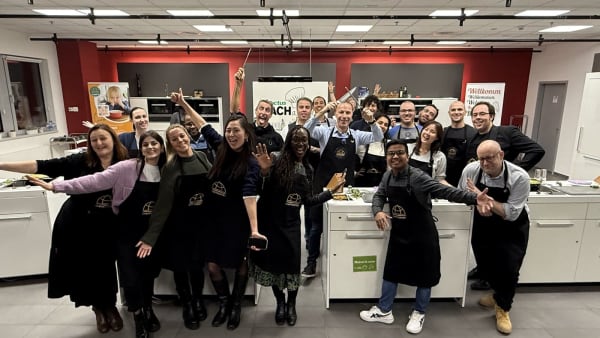
Collaborative cooking isn't passive. It demands the same real-time coordination, communication under pressure and shared-goal structure that sports require — but without the physical disparities or weather gambles. Here's what happens in a live, hosted cooking session at ChefPassport's Windhof venue.
Coordination and timing
Teams divide into cooking stations. One group preps vegetables, another manages proteins, a third handles sauces. Everyone's output feeds into the final dish, so timing matters. If the pasta finishes before the sauce is ready, coordination has failed. If the garnish team doesn't communicate portion size, plating breaks down. These are the same delegation, handoff and dependency-management challenges teams face in quarterly sprints or product launches — just with lower stakes and higher sensory reward.
Challenge and skill progression
Participants learn new techniques: knife skills, emulsification, sauce reduction, plating. The learning curve is steep enough to feel like genuine progress, but gentle enough that no one is left behind. A professional chef guides every step, troubleshoots mistakes in real time and adapts the pace to the room. The sense of achievement when a group plates a restaurant-quality dish together is immediate and shared.
Immediate, tangible reward
You sit down together and eat what you made. There's no abstraction, no delayed gratification. The meal is the proof of teamwork, and the conversation during the meal is where connection actually happens — stories, laughter, the colleague who turns out to have grown up on a farm in the Moselle or learned to cook from a grandmother in Kerala. These moments don't emerge in a debrief slide deck.
Inclusive by default
Cooking accommodates dietary restrictions, physical limitations and varying levels of confidence. A participant with limited mobility can lead sauce prep while someone else handles the chopping. A team member who doesn't drink can focus on mocktails or dessert. The format bends to the people, not the other way around.
After running sessions for multinational teams across industries, we consistently hear the same feedback: people who were quiet in the morning briefing became vocal at the stove. Cross-border colleagues who rarely spoke outside Zoom calls found common ground over a shared disaster with béchamel. The activity itself is the icebreaker.
When team building sport is the right choice
Sports-based team building isn't wrong — it's context-dependent. If your team is already cohesive, shares a baseline fitness level and actively enjoys physical competition, a football tournament or obstacle course can be exhilarating. Sales teams, field engineers and operations groups often thrive in high-energy, competitive formats.
Sports work best when:
- The group is small (≤15 people) and knows each other well.
- Everyone has opted in — participation is genuinely voluntary, not socially coerced.
- The activity matches the group's physical ability and interest.
- You have weather contingencies and accessible infrastructure.
- The goal is celebration or reward, not integration or trust-building.
For onboarding new hires, integrating cross-functional groups or rebuilding morale after a difficult quarter, inclusive formats deliver better outcomes. The objective isn't to find the fittest athlete — it's to create conditions where trust, communication and shared success can happen naturally.
Practical comparison: sports vs cooking for Luxembourg corporate teams
Here's how the most common team building sport options compare to collaborative cooking in Luxembourg's specific context — infrastructure scarcity, weather variability, multilingual teams and budget pressure.
| Format | Strengths | Limitations | Best for |
|---|---|---|---|
| Football / Futsal | Familiar, energising, competitive | Fitness disparity, injury risk, gendered assumptions, indoor capacity limited | Young, active, male-majority teams |
| Padel | Trending, social, accessible rules | Very limited courts in Luxembourg, high booking cost, still requires baseline coordination | Small, fit, socially connected groups |
| Hiking / Trails | Scenic, low cost, leverages Luxembourg's nature | Weather-dependent, mobility barriers, limited interaction during activity | Outdoorsy teams, fair-weather months |
| Obstacle Course | High energy, clear challenge, team reliance | High fitness requirement, injury risk, intimidating for many, limited venues | Confident, athletic, tight-knit teams |
| Bowling | Indoor, low fitness barrier, relaxed | Limited interaction, passive for some, not memorable | Casual afterwork, low-stakes socialising |
| Collaborative Cooking | Inclusive, skill-neutral, weather-proof, multilingual, immediate reward, strong interaction | Not physically energising; may feel "soft" to competitive personalities | Diverse, cross-functional, international or newly formed teams |
No single format fits every team. The question to ask is: does this activity reduce barriers to connection, or introduce new ones? If the answer is the latter, you're optimising for optics, not outcomes.
What to expect from a collaborative cooking session in Luxembourg
A typical in-person cooking class at our Windhof venue runs 2.5 to 3 hours. Teams of 10 to 40 people work in smaller groups of 4–6, each responsible for part of a multi-course menu. The chef instructor introduces techniques, demonstrates knife skills or sauce work, then steps back while participants execute. Mistakes happen — burnt garlic, over-salted broth, a collapsed soufflé — and the chef troubleshoots in real time, turning errors into teaching moments.
Menus range from Luxembourgish classics (Judd mat Gaardebounen, Gromperekichelcher) to Thai street food, Italian pasta from scratch or Middle Eastern mezze. The cuisine matters less than the structure: every dish requires delegation, timing and communication. Teams plate together, then sit down family-style to eat and debrief. The conversation is organic — no forced "what did we learn" slide deck.
For distributed or hybrid teams, the same format works virtually. Ingredient kits ship across Europe, and a live chef hosts the session over Zoom or Teams. Participants cook in their own kitchens, but the structure — shared timing, live troubleshooting, simultaneous plating — keeps the group connected. Remote and hybrid formats have become standard for multinational teams headquartered in Luxembourg but employing people across the EU.
How to choose the right team-building format for your Luxembourg team
Start with your real objectives, not the activity trend. Ask:
- Who is this event for? A homogeneous department or a cross-functional, multilingual, multigenerational group?
- What's the goal? Celebrate a win, integrate new hires, rebuild trust after a reorganisation, or simply give people a reason to talk to each other?
- What are the constraints? Budget, weather, accessibility, dietary restrictions, time of year, travel logistics?
- What's the risk of exclusion? Will anyone feel uncomfortable, exposed or unable to participate fully?
If the answers point toward inclusion, weather independence and genuine interaction, collaborative cooking will outperform most sports formats. If the group is already cohesive, opts in enthusiastically and shares a physical baseline, a well-designed sports event can work beautifully.
The mistake is choosing the activity first and forcing the team to fit. The format should serve the people, not the other way around.
Team building that matches your team's reality
Team building sport has a place — when the group is right, the weather cooperates and everyone genuinely wants to compete. But for Luxembourg's dispersed, multilingual, cross-border workforce, inclusive formats that prioritise coordination, skill-building and shared reward often deliver stronger, more lasting outcomes. Collaborative cooking isn't a soft alternative to sports; it's a different kind of challenge, one that mirrors the delegation, timing and communication your team uses every day — just with better food and no risk of a sprained ankle.
If you're planning an event for a diverse team and want a format that works for everyone, not just the athletes, we'd be glad to walk through what a session at our Windhof venue looks like in practice. Explore our Luxembourg team-building cooking classes or get in touch to design something tailored to your group's size, objectives and constraints.
Planning a team event?
ChefPassport runs hands-on cooking experiences for corporate teams — in person at Kachatelier, Luxembourg, and virtually worldwide. Instant price estimate on the site.
Frequently asked questions
Free guide
Team Building Menu & Pricing Guide
Menus, group sizes, formats and indicative pricing — everything you need to plan, in two PDFs. No spam, unsubscribe anytime.