Team building éco-responsable means designing corporate events that align employee engagement with environmental and social responsibility. In Luxembourg, where 47% of employees are cross-border workers and sustainability expectations are rising, eco-responsible team building combines measurable impact—local sourcing, waste reduction, accessible transport—with genuine connection, not greenwashed gestures.
HR managers and office leaders face mounting pressure to deliver events that reflect stated CSR commitments. The challenge is separating real sustainability from vendor promises, especially in a multilingual, distributed workforce where every choice—venue, transport, catering, packaging—carries environmental and social weight.
Key takeaways
- Eco-responsible team building prioritises measurable impact: short supply chains, seasonal ingredients, waste elimination, and accessible venues that reduce individual car journeys.
- Greenwashing is rife in the event industry—verify supplier claims with specifics: farm names, transport distances, packaging materials, and waste handling.
- Cooking workshops naturally embody sustainability: they use fresh, local produce, create zero single-use plastic, and foster skill-building that extends beyond the event.
- In Luxembourg's hybrid, cross-border context, eco-responsibility also means inclusive design—choosing central locations and formats that don't penalise remote or part-time colleagues.
What defines an eco-responsible team building event in Luxembourg
An eco-responsible team building event minimises environmental harm and ideally creates social value, without sacrificing engagement or outcomes. For Luxembourg-based teams, that means addressing the unique geography: a small, dense, multilingual country where nearly half the workforce crosses a border daily and sustainability consciousness runs high.
Concrete criteria include:
- Local, seasonal sourcing: Ingredients or materials drawn from farms and producers within the region—Moselle Valley, Mullerthal, Éislek—reducing transport emissions and supporting the local agricultural economy.
- Waste reduction: Eliminating single-use plastics, composting organic waste, and designing activities that produce minimal or reusable outputs.
- Accessible, central venues: Locations reachable by public transport or within walking distance of major employment hubs (Kirchberg, Cloche d'Or, Gasperich) to reduce reliance on individual cars.
- Transparent supply chains: Vendors who can name their suppliers, provide evidence of certifications (organic, fair trade, carbon offset), and quantify impact—not just claim it.
- Inclusive format: Activities that accommodate dietary restrictions, physical abilities, and remote participants when hybrid attendance is needed.
After running hundreds of corporate cooking events in Luxembourg, we've found that the most credible eco-responsible formats share one trait: they make sustainability visible and participatory, not an afterthought mentioned in a closing slide.
Why cooking team building naturally supports eco-responsibility
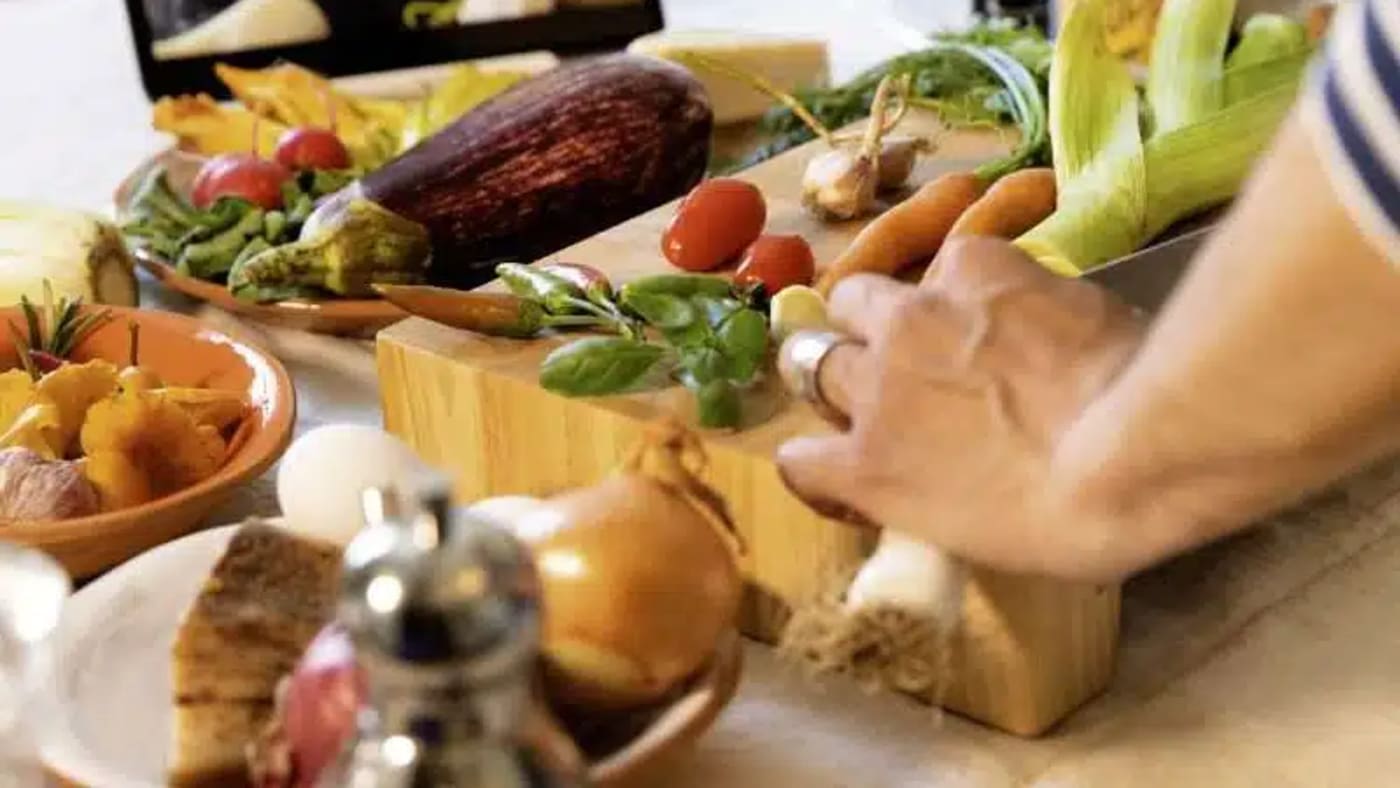
Cooking workshops embody several sustainability principles by design. Participants handle fresh, whole ingredients—carrots with soil, herbs with stems, tomatoes that smell like summer—not pre-portioned kits wrapped in plastic. The sensory experience itself reinforces the connection between food choices and environmental impact.
Here's how a well-run cooking team building session aligns with CSR goals:
- Short supply chains: Seasonal produce from Luxembourg and Greater Region farms arrives the morning of the event. In our corporate cooking classes in Luxembourg, vegetables often come from Moselle growers, dairy from Éislek cooperatives, and herbs from local market gardens—distances measured in kilometres, not countries.
- Zero single-use plastic: Ingredients arrive in reusable crates; participants use stainless bowls, ceramic plates, and cloth towels. There are no portion sachets, foil trays, or disposable cutlery.
- Organic waste composted: Peels, stems, and scraps go to municipal compost or partner farms, not landfill. Food surplus—rare, because portions are calibrated—is shared or donated.
- Skill transfer: Unlike passive events, cooking teaches techniques participants use at home: knife skills, seasonal menu planning, batch cooking to reduce waste. The sustainability lesson outlasts the event.
- Inclusive and adaptable: Menus accommodate vegan, gluten-free, halal, and kosher requirements without creating separate "special" portions—everyone cooks and eats together.
Compared to off-site adventures requiring coach transport, catered events with single-use serving ware, or wellness retreats flown in from abroad, a local cooking workshop keeps the carbon footprint tight and the impact measurable.
Common greenwashing traps in corporate events (and how to avoid them)

Greenwashing is the gap between a vendor's sustainability claims and their actual practices. In the event industry, it often appears as vague language—"eco-friendly," "carbon-neutral," "sustainable"—without evidence. HR teams under time pressure are especially vulnerable.
Watch for these red flags:
| Greenwashing claim | Reality check | What to ask |
|---|---|---|
| "We use sustainable ingredients" | No supplier names, no seasonality, no certification | Which farms? What's in season this month? Can I see your invoices or supply list? |
| "Carbon-neutral event" | Offsets purchased without reducing actual emissions | What's your measured baseline? What did you eliminate before offsetting? |
| "Zero waste" | Waste sent to external contractor; no composting or reuse in-house | Where does organic waste go? Do you track volumes? Can I see waste logs? |
| "Eco-friendly packaging" | Biodegradable plastic that requires industrial composting Luxembourg lacks | Is it compostable at home or only industrially? What happens to it after the event? |
| "Local catering" | Caterer is local; ingredients are imported | Where are the ingredients sourced? What percentage is Luxembourg or Greater Region? |
The most reliable vendors provide specifics unprompted: farm names, transport distances in km, waste weights, and photographs of compost bins or reusable crate deliveries. If a supplier hesitates or deflects when you ask for evidence, assume the claim is aspirational, not operational.
How to evaluate a team building provider on real sustainability impact
When vetting potential providers, shift the conversation from marketing promises to operational proof. A genuinely eco-responsible vendor will welcome detailed questions—they've built systems to answer them.
Ask these questions during your initial call:
- Ingredient sourcing: "Can you name three farms or producers you work with? What's in season in Luxembourg this month, and will that appear in our menu?"
- Waste handling: "What happens to food scraps, packaging, and surplus? Do you compost on-site or partner with a municipal programme?"
- Transport and venue: "Is your venue accessible by RGTR bus or tram? If we have remote participants, can the format include them without creating separate 'virtual' and 'in-person' experiences?"
- Packaging and materials: "Do ingredients arrive in single-use plastic or reusable containers? Are utensils, plates, and bowls reusable or compostable?"
- Measurement: "Can you quantify the carbon or waste footprint of a typical session? Do you track and share those metrics?"
Strong providers will offer to walk you through their kitchen, show you supplier invoices, or introduce you to their farmers. Weak ones will redirect to a PDF with stock sustainability icons.
After running team-building events for Amazon, Google, the ECB, Deloitte, and JP Morgan, we've learned that clients increasingly audit our claims. We respond by sharing farm delivery schedules, compost pick-up logs, and seasonal menu rotations—not because it's required, but because transparency is the only credible foundation for eco-responsibility.
Why Luxembourg's cross-border workforce makes sustainability harder (and more important)
Luxembourg's labour market is unusual: 47% of employees are cross-border workers, and 27.3% sometimes work from home—well above the EU27 average. That geography shapes sustainability in two ways.
First, transport footprint. If your team building event is in a remote countryside venue, many attendees will drive alone from France, Belgium, or Germany, multiplying emissions. A central Luxembourg City location—Kirchberg, Gare, Cloche d'Or—accessible by train, bus, and tram, cuts individual car journeys and makes participation easier for colleagues without vehicles.
Second, inclusion as a sustainability issue. Forcing cross-border or hybrid workers to travel for an in-person-only event can exclude parents, part-timers, or those with visa or mobility constraints. A genuinely responsible event design offers hybrid or fully in-person options that don't penalise distributed colleagues—because social sustainability (equity, inclusion) is inseparable from environmental sustainability.
For teams with a significant remote presence, consider alternating: in-person cooking workshops for Luxembourg-based staff, and separate or parallel virtual team building cooking classes for distributed colleagues, using the same seasonal menu and instructor to maintain shared experience.
The hidden sustainability advantage of skill-building formats
Most team building events are consumed and forgotten. An escape room ends when you leave. A paintball session produces no transferable skill. A catered lunch generates waste, not knowledge.
Cooking workshops are different: participants leave with techniques—knife skills, sauce emulsification, flavour balancing—they use at home. That knowledge compounds. A colleague who learns to cook seasonal vegetables buys less pre-packaged convenience food. Someone who masters batch cooking wastes less and shops less frequently. The sustainability impact extends beyond the corporate event into daily life.
After hundreds of sessions, we see this pattern: participants ask for the recipe, photograph the steps, and message us weeks later with photos of the dish made at home. That long tail—repeated sustainable behaviour—is rarely factored into event ROI, but it's where the real environmental return lies.
How ChefPassport delivers eco-responsible team building in Luxembourg
At our Kachatelier venue in Luxembourg, eco-responsibility isn't a feature we've added—it's embedded in how we operate. Every decision, from ingredient procurement to waste handling, reflects the sustainability criteria HR teams now expect.
Here's what that looks like in practice:
- Seasonal, local menus: We design menus around what's available in Luxembourg and the Greater Region that month. Winter sessions feature root vegetables from Éislek, spring menus showcase Moselle asparagus, autumn workshops use squash and mushrooms from local farms. We know our suppliers by name, not catalogue.
- Zero single-use plastic: Ingredients arrive in reusable crates. We use stainless steel bowls, ceramic plates, glass, and cloth. No portion sachets, no cling film, no disposable cutlery.
- Composting and waste tracking: Organic waste is composted through municipal partners. We measure waste per session and adjust purchasing to minimise surplus.
- Accessible central location: Kachatelier is in Luxembourg City, reachable by tram, RGTR bus, and train. Colleagues from Esch, Ettelbruck, or across the border in Trier, Arlon, or Thionville can attend without driving.
- Inclusive menu design: Vegan, gluten-free, halal, and kosher requirements are integrated into the main menu—no separate "allergy" plates. Everyone cooks and eats the same dishes.
- Hybrid capability: For distributed teams, we offer parallel virtual sessions using the same menu and instructor, so remote colleagues in other countries cook alongside Luxembourg-based participants in real time.
We don't offset carbon or buy certificates. We reduce emissions and waste at the source, then measure what remains. When an HR manager asks for evidence, we share supplier invoices, compost logs, and seasonal menu rotations—because credibility requires proof, not promises.
What to expect during an eco-responsible cooking team building session
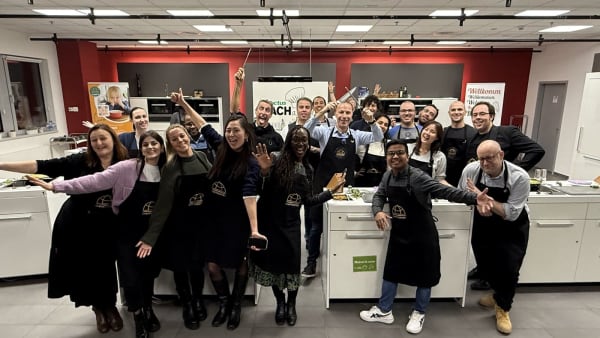
A typical session at Kachatelier begins with ingredient introduction. The instructor names the farms: "These tomatoes are from Munsbach, the herbs from a market garden in Mersch, the butter from an Éislek cooperative." Participants see whole vegetables, smell fresh herbs, and handle ingredients that arrived that morning.
Teams work in small groups of four to six, each with a cooking station. The format is hands-on: everyone chops, sautés, and plates. The instructor demonstrates techniques—how to brunoise a carrot, deglaze a pan, balance acidity—then circulates to coach. There's no passive observation.
Midway through, participants notice there's no bin liner, no plastic wrap, no disposable anything. Scraps go into a stainless compost pail. Utensils are washed and reused. The absence of waste becomes a talking point—several teams have told us it sparked internal conversations about office kitchen practices.
The session ends with a shared meal: everyone eats what they've cooked, family-style, at a communal table. Conversation shifts from recipes to broader food choices—seasonality, supply chains, home cooking habits. The sustainability lesson is experiential, not lectured.
Participants leave with a recipe card (printed on recycled paper or emailed), new skills, and a tangible sense that the event aligned with, rather than contradicted, their company's CSR commitments.
Eco-responsibility as competitive advantage in employer branding
Sustainability is no longer a nice-to-have in employer branding—it's a filter. Younger workers are strongly motivated by meaning and well-being, and they scrutinise whether corporate values are lived or merely claimed. A team building event that visibly contradicts stated CSR commitments—imported ingredients, single-use plastic, inaccessible venue—sends a louder signal than any careers page copy.
Conversely, an eco-responsible event becomes proof. When a new hire attends a cooking workshop and sees local produce, composting, and zero-waste operation, they experience the company's sustainability commitment as real, not rhetorical. That tangible alignment strengthens trust, belonging, and retention.
For Luxembourg employers competing in a tight, multilingual talent market, eco-responsible team building is both a culture reinforcer and a recruiting asset—evidence that values translate into everyday decisions.
Measuring the impact of eco-responsible team building
Measurement separates genuine sustainability from performative gestures. Track these metrics before, during, and after your event:
- Carbon footprint: Estimate transport emissions (venue location, attendee travel mode), ingredient sourcing (km travelled), and waste (landfill vs compost weight). Many providers can't quantify this—ask anyway.
- Waste volume: Request a post-event waste report: total kg, percentage composted, percentage recycled, percentage landfill. A good provider tracks this per session.
- Local sourcing percentage: What share of ingredients, by cost or weight, came from Luxembourg or the Greater Region? Aim for >70%.
- Participant feedback: Ask whether the event felt aligned with company values. Include an open-text question: "Did this experience reflect our sustainability commitments? How?"
- Behaviour change: Three months later, survey participants: "Have you changed any home cooking or food-purchasing habits since the session?" Durable impact is the ultimate measure.
After running team building activities in Luxembourg for nearly two hundred companies, we've found that teams value transparency over perfection. Sharing honest metrics—"This session produced 2.3 kg of compost and 0.1 kg of landfill waste"—builds more trust than claiming "zero waste" without proof.
Common questions HR teams ask about eco-responsible team building
Does eco-responsible mean more expensive?
Not necessarily. Local, seasonal ingredients are often cheaper than imported or out-of-season produce. Waste reduction lowers disposal costs. Central venues reduce transport subsidies. The perception of higher cost usually comes from providers adding a "sustainability premium" to the same service. Ask for an itemised quote.
Can we do eco-responsible team building virtually?
Yes. Virtual cooking classes eliminate travel emissions entirely. Ingredient kits can be sourced locally in each participant's country, composted at home, and delivered in reusable packaging. The carbon footprint of a well-designed virtual session is a fraction of an in-person event requiring flights or long drives. Learn more about virtual team building activities that work.
How do I verify a provider's sustainability claims?
Ask for evidence: farm names, supplier invoices, compost partner details, waste logs, transport distances. A credible provider will share this unprompted or within 24 hours. If they deflect, stall, or offer only marketing PDFs, assume greenwashing.
What if my team has diverse dietary restrictions?
Eco-responsible and inclusive are inseparable. A strong provider integrates vegan, gluten-free, halal, and kosher requirements into the main menu—no separate "allergy" portions. Everyone cooks and eats together, which strengthens the team-building outcome.
Is cooking the only eco-responsible team building format?
No, but it's one of the most naturally aligned. Other strong options include urban foraging workshops, zero-waste craft sessions, and volunteer days with local environmental NGOs. Avoid formats that require long transport, generate non-recyclable outputs, or rely on imported materials.
Ready to align your next team building with your CSR commitments?
Eco-responsible team building in Luxembourg isn't about compromise—it's about designing events where sustainability, engagement, and measurable outcomes reinforce one another. The best sessions leave participants skilled, connected, and proud that the experience reflected the values their company claims to hold.
If you're planning a team event in the coming weeks or months and want to ensure it aligns with your CSR strategy—local sourcing, waste reduction, accessible format, transparent impact—book a twenty-minute call with our team. We'll walk you through how a corporate cooking class at our Luxembourg venue delivers on those commitments without compromising on experience, and share the specific metrics you can expect.
No hard sell. Just a practical conversation about what eco-responsibility looks like in practice, and whether a cooking workshop makes sense for your team. Get in touch here.
Planning a team event?
ChefPassport runs hands-on cooking experiences for corporate teams — in person at Kachatelier, Luxembourg, and virtually worldwide. Instant price estimate on the site.
Frequently asked questions
Free guide
Team Building Menu & Pricing Guide
Menus, group sizes, formats and indicative pricing — everything you need to plan, in two PDFs. No spam, unsubscribe anytime.